
Interdisciplinary Journal of the African Alliance for Research, Advocacy and Innovation
IJAARAI
E-ISSN: 3093-4664
AI Ambition versus ICT Reality: Assessing Ghana’s ICT Sector Readiness for Large-Scale Artificial Intelligence Growth
Article Information
Abstract
Keywords
Full Article
1.0 Introduction
Artificial intelligence is no longer a distant concept in global development. It has become a central force in shaping productivity, public service delivery, industrial systems, and knowledge economies. Countries that can integrate AI into their economic and governance structures gain significant advantages in terms of competitiveness and innovation. Simultaneously, the effectiveness of AI deployment depends heavily on the strength of the underlying digital infrastructure, data systems, and human capacity. Without these foundations, AI ambitions often remain theoretical rather than practical (International Telecommunication Union 2024).
Governments worldwide are investing in national AI strategies as part of broader digital transformation agendas. These strategies are designed to improve efficiency in healthcare, education, agriculture, finance and governance. However, the success of these strategies varies widely across countries. In high-income economies, strong broadband networks, advanced cloud infrastructure, and deep technical talent pools support rapid AI adoption. In many developing countries, including those in sub-Saharan Africa, the situation is different. Infrastructure gaps, limited computing resources, and shortages of specialized skills continue to slow down meaningful AI integration (World Bank, 2023).
Ghana has positioned itself as an emerging digital economy in Africa. Over the past decade, the country has made progress in mobile connectivity, fintech expansion, and e-governance systems. National policy documents also reflect a strong ambition to leverage artificial intelligence for economic transformation and public sector improvement (Ministry of Communications and Digitalization, 2024). Despite this ambition, concerns remain regarding whether the current ICT ecosystem is sufficiently developed to support large-scale AI deployment. Issues such as uneven broadband coverage, limited data center capacity, and gaps in advanced digital skills continue to shape Ghana’s national digital landscape (Ghana Statistical Service, 2023).
The tension between ambition and readiness raises important questions regarding implementation feasibility. While the policy direction is clear, the operational environment may not yet fully support large-scale AI systems. This creates a gap that must be systematically assessed to understand both the opportunities and limitations. Without such an assessment, there is a risk of overestimating capacity and underestimating structural constraints in the ICT sector in the future.
Therefore, this study examines the relationship between Ghana’s AI ambitions and the actual readiness of its ICT sector for large-scale artificial intelligence adoption. It focuses on key dimensions such as digital infrastructure, human capital, data ecosystems, innovation capacity, and governance. These dimensions provide a structured way of understanding how prepared a country is for AI-driven transformation.
A summary of Ghana’s ICT development indicators is presented in Table 1.1: Key ICT Development Indicators in Ghana, which highlights trends in connectivity, internet usage, and digital access.
Table 1.1: Key ICT Development Indicators in Ghana
| Indicator | Latest Available Estimate | Trend | Interpretation for AI Readiness |
| Mobile cellular subscriptions (per 100 people) | High penetration (above 100% in recent years) | Increasing, but plateauing | Strong mobile access supports digital inclusion, but not sufficient for advanced AI systems |
| Internet penetration rate | Moderate (urban biased access) | Gradual increase | Indicates improving connectivity, but uneven access limits nationwide AI deployment |
| Broadband internet subscriptions | Relatively low compared to mobile usage | Slow growth | A key constraint for cloud based AI services and high performance computing |
| Fixed broadband coverage | Limited national reach | Weak expansion | Restricts stable high speed data access needed for AI training and deployment |
| Data center infrastructure | Emerging, concentrated in urban centers | Growing but underdeveloped | Limits local compute capacity and increases reliance on foreign cloud providers |
| ICT contribution to GDP | Moderate contribution | Steady growth | Shows digital economy potential but not yet AI intensive transformation |
| Digital skills availability (advanced ICT/AI skills) | Limited supply of AI specialists | Slow improvement | Major constraint for AI research, development, and deployment |
| E government service availability | Expanding digital public services | Improving | Positive foundation for AI integration in governance systems |
This study was guided by the following research questions: First, how aligned is Ghana’s ICT infrastructure with its stated AI ambitions? Second, what gaps exist in skills, infrastructure, and governance that may affect AI deployment? Third, what policy measures can strengthen readiness for sustainable AI adoption?
The significance of this study lies in its contribution to the ongoing discussions on digital transformation in developing economies. It provides evidence-based insights that can support policymakers, researchers, and industry actors in understanding the conditions shaping AI adoption in Ghana. It also contributes to broader debates on how African countries can transition from digital adoption to meaningful AI integration.
In summary, this study positions Ghana’s AI ambitions within the reality of its ICT development context. It argues that successful AI transformation depends not only on policy intent but also on the strength and maturity of foundational digital systems.
2.0 Methodology
This study adopted a qualitative desk-based research design. The aim is to assess Ghana’s readiness for large-scale artificial intelligence adoption by examining existing evidence rather than collecting primary field data. This approach is appropriate because AI readiness is a multidimensional issue that requires the synthesis of policy documents, development indicators, and prior research findings rather than isolated observations.
This study relies on secondary data from international development institutions, government publications, and peer-reviewed academic literature. The key data sources include the International Telecommunication Union, World Bank, Ghana Statistical Service, and Ministry of Communications and Digitalization. These sources were selected because they provide reliable and comparable indicators of digital infrastructure, connectivity, and ICT development trends (International Telecommunication Union, 2024; World Bank, 2023).
In addition to institutional reports, this study draws on recent academic literature on artificial intelligence readiness and digital transformation in developing economies. These studies help frame Ghana’s situation within broader global and regional discussions on AI adoption, infrastructure gaps, and digital inequality (Maslej et al., 2024; OECD, 2024).
The analytical framework for this study was built around five key dimensions of AI readiness. These include digital infrastructure, human capital, data ecosystem maturity, innovation capacity, and governance. Each dimension represents a critical pillar required for the effective deployment of AI at scale. Together, they provide a structured lens for evaluating both the strengths and gaps within Ghana’s ICT sector.
Digital infrastructure refers to broadband connectivity, mobile network coverage, data center availability, and cloud computing capacity. Human capital focuses on the availability of ICT professionals, data scientists and AI specialists. The data ecosystem examines the availability, accessibility, and quality of data for machine-learning applications. Innovation capacity considers the presence of startups, research institutions, and industry engagement in artificial intelligence (AI) development. Governance structures include policies, regulatory frameworks, and institutional coordination.
A thematic analysis approach was used to examine the collected data. This involved identifying recurring patterns across the five readiness dimensions and interpreting their implications for AI adoption in Ghana. The analysis also includes comparative benchmarking, where Ghana is positioned against selected African countries with relatively advanced digital ecosystems. This helps contextualize Ghana’s readiness within the continental landscape.
Table 2.1: Analytical Framework for Ghana’s AI Readiness Assessment presents the five dimensions and their corresponding indicators used in this study.
Table 2.1: Analytical Framework for Ghana AI Readiness Assessment
| Readiness Dimension | Key Indicators | What It Measures | Relevance to AI Deployment |
| Digital Infrastructure | Broadband penetration, mobile network coverage, data centers, cloud computing access | Availability and quality of ICT infrastructure | Determines whether AI systems can be deployed, accessed, and scaled efficiently |
| Human Capital | Number of ICT professionals, AI specialists, data scientists, STEM graduates | Availability of skilled workforce | Directly affects ability to develop, maintain, and innovate AI systems locally |
| Data Ecosystem | Data availability, data quality, digitization of public records, data governance | Readiness of usable data for AI systems | AI systems depend heavily on structured, accessible, and high quality data |
| Innovation Capacity | Startup ecosystem strength, research output, tech hubs, industry adoption of AI | Level of AI innovation and experimentation | Indicates how actively AI is being developed and applied in the economy |
| Governance and Regulation | Data protection laws, AI policy frameworks, institutional coordination | Policy and regulatory environment for AI | Ensures ethical, secure, and well regulated AI deployment |
Source Note:
Developed by the author based on frameworks adapted from the International Telecommunication Union (2024), OECD (2024), Oxford Insights (2024), and World Bank (2023).
The study is limited by its reliance on secondary data, which may not fully capture the real-time developments in Ghana’s rapidly evolving digital sector. However, by triangulating multiple authoritative sources, this study ensured a balanced and credible assessment of ICT readiness for artificial intelligence growth.
3.0 Ghana’s ICT and AI Landscape
Ghana’s information and communication technology sector has undergone a substantial transformation over the past two decades. Continuous investment in telecommunications infrastructure, expansion of mobile connectivity, and increasing digital service delivery have contributed to the country’s emergence as one of the leading digital economies in West Africa. Public sector reforms and private sector innovations have accelerated the adoption of digital technologies across finance, education, healthcare, agriculture, commerce, and public administration. These developments have created an enabling environment for digital innovation and strengthened the foundation upon which artificial intelligence applications can be developed and deployed (World Bank, 2023).
The expansion of mobile telecommunications has been one of the most significant drivers of Ghana’s digital transformation. Mobile network coverage now reaches the vast majority of the population, and mobile broadband subscriptions continue to increase as smartphones become more affordable. Internet usage has also grown steadily over the past decade, supported by investments in fourth-generation mobile networks and improvements in national fiber-optic infrastructure. According to the International Telecommunication Union (2024), Ghana has made consistent progress in expanding digital connectivity, although disparities in broadband quality and Internet accessibility remain between urban and rural communities.
Digital transformation has also been strengthened through a series of government initiatives aimed at improving public service delivery and promoting digital economies. The implementation of the National Identification System, Ghana Card, Digital Property Address System, mobile money interoperability, and online government service platforms has significantly increased digital participation among citizens and businesses. These initiatives have improved access to financial services, enhanced administrative efficiency, and generated large volumes of digital data that can support future AI applications (Ministry of Communications and Digitalization, 2024).
The financial technology sector provides one of the strongest examples of Ghana’s digital progress. The widespread adoption of mobile money and digital payment platforms has transformed financial inclusion by extending formal financial services to previously unserved populations. Digital transactions continue to increase each year, demonstrating growing public confidence in digital platforms and providing an expanding ecosystem of digital data that can support intelligent financial services. The Bank of Ghana has also introduced regulatory measures that encourage innovation while maintaining financial stability, thereby creating favorable conditions for technology-driven financial services (Bank of Ghana, 2024).
Alongside government reforms, Ghana’s innovation ecosystem has expanded considerably. Technology hubs, business incubators, startup accelerators, and research institutions have supported entrepreneurship and digital innovation in multiple sectors. Cities such as Accra have become centers for technology startups developing solutions in agriculture, healthcare, education, logistics, financial services, and electronic commerce. Universities have also increased their investments in computer science, data science, robotics, and artificial intelligence education, producing a growing number of graduates with digital competencies. Despite these positive developments, AI-specific research and commercialization remain relatively limited compared to more established innovation ecosystems elsewhere on the continent.
Artificial intelligence is increasingly recognized as a strategic technology capable of accelerating Ghana’s socio-economic development. Emerging AI applications are beginning to appear in disease diagnosis, precision agriculture, financial risk assessment, educational technologies, customer service automation and business analytics. Both public and private institutions are exploring opportunities to integrate AI into service delivery and decision-making. However, most of these initiatives remain at the pilot or early adoption stage and have yet to achieve large-scale implementation.
The development of AI depends not only on software and algorithms but also on the availability of reliable digital infrastructure, quality data, advanced computing resources, skilled professionals, and effective governance. Although Ghana has achieved significant progress in expanding ICT services, several structural challenges continue to limit AI readiness. Broadband speeds vary across regions, fixed broadband penetration remains relatively low, local data center capacity is still developing, and access to high-performance computing infrastructure is limited. These constraints increase dependence on foreign cloud service providers and raise concerns regarding data sovereignty, operational costs, and long-term sustainability (International Telecommunication Union, 2024).
Human capital is another important consideration. Ghana has made considerable progress in expanding tertiary education and ICT-related programs. Nevertheless, there remains a shortage of highly specialized professionals in artificial intelligence, machine learning, data engineering, and cloud computing fields. Many organizations continue to experience difficulties in recruiting professionals with advanced digital skills, while competition for experienced AI talent has increased globally. This skills gap has implications for research productivity, technology transfer, and the commercialization of AI innovations in the country (World Economic Forum, 2023).
The policy environment continues to evolve in response to the growing importance of digital technologies. Ghana has enacted legislation to strengthen data protection, cybersecurity, and electronic transactions, and national digital policies continue to promote innovation and digital inclusion. Although these initiatives provide an important regulatory foundation, comprehensive governance frameworks specifically addressing artificial intelligence, including issues related to transparency, accountability, ethical use, algorithmic bias, and responsible innovation, are still being developed. As AI technologies become more integrated into economic and social systems, strengthening governance will become increasingly important.
Overall, Ghana possesses many of the foundational elements required to support AI-driven development. Strong mobile penetration, expanding digital services, increasing innovation activities, and sustained government commitment demonstrate significant progress toward a digital economy in Indonesia. Simultaneously, limitations in digital infrastructure, advanced technical skills, computing capacity, data maturity, and AI-specific governance indicate that important readiness gaps remain. Understanding these strengths and constraints provides the necessary context for evaluating Ghana’s preparedness for large-scale artificial intelligence growth.
Figure 3.1 presents the conceptual framework adopted in this study, illustrating how the five dimensions of ICT readiness jointly influence Ghana’s capacity to achieve sustainable and scalable AI development in the health sector. The subsequent section evaluates each dimension using recent national and international evidence.
Table 3.1: Overview of Ghana’s ICT and AI Landscape
| Component | Current Status | Key Achievements | Remaining Challenges |
| Digital Infrastructure | Expanding mobile and broadband networks with increasing internet connectivity | Improved national fibre backbone, wider 4G coverage, growth in digital connectivity | Uneven broadband quality, limited fixed broadband penetration, inadequate high performance computing infrastructure |
| Digital Government | Rapid digitalization of public services | Ghana Card, Digital Property Address System, online government services, digital tax administration | Limited interoperability among some government information systems and uneven digital service adoption |
| Financial Technology | One of the fastest growing fintech ecosystems in West Africa | Mobile money interoperability, digital payments, increased financial inclusion, supportive regulatory environment | Cybersecurity risks, digital literacy gaps, limited AI integration in financial services |
| Innovation Ecosystem | Growing technology startup and innovation hub landscape | Expansion of incubators, accelerators, university innovation centres, private sector digital solutions | Limited venture capital, inadequate AI research funding, weak commercialization of research outputs |
| Human Capital | Increasing ICT and STEM graduates | Expansion of computer science and ICT programmes in tertiary institutions | Shortage of AI specialists, machine learning engineers, data scientists, and cloud computing experts |
| Data Ecosystem | Increasing generation of digital data across public and private sectors | Greater digitization of government records and digital financial transactions | Fragmented data systems, limited data sharing, concerns about data quality and accessibility |
| Policy and Governance | Strong commitment to digital transformation | Digital Economy Policy, Data Protection Act, Cybersecurity Act, digital inclusion initiatives | Absence of a comprehensive national AI strategy and evolving AI governance framework |
4.0 Ghana’s ICT Sector Readiness for Large Scale Artificial Intelligence Growth
Artificial intelligence depends on a robust digital ecosystem that can support data-intensive computation, continuous connectivity, and knowledge-driven innovation. Countries seeking to deploy AI at scale require reliable digital infrastructure, skilled human resources, quality data, vibrant innovation ecosystems and supportive governance. Although Ghana has made substantial progress in digital transformation, the extent to which its ICT sector can sustain large-scale AI growth remains an important policy question. This section evaluates Ghana’s readiness across the five interrelated dimensions identified in the analytical framework.
The assessment is based on recent national and international indicators and emphasizes both existing strengths and areas that require further investment. Rather than measuring AI adoption alone, the analysis examines whether a country’s ICT ecosystem provides the enabling conditions necessary for sustainable AI development.
4.1 Digital Infrastructure Readiness
Digital infrastructure forms the foundation on which artificial intelligence systems are developed, deployed, and scaled. High-speed Internet, reliable telecommunications networks, cloud computing services, and data centers collectively provide the computational environment required for AI applications. Countries with well-developed digital infrastructure are generally better positioned to attract AI investment, support innovation, and facilitate digital transformation across economic sectors (International Telecommunication Union, 2024).
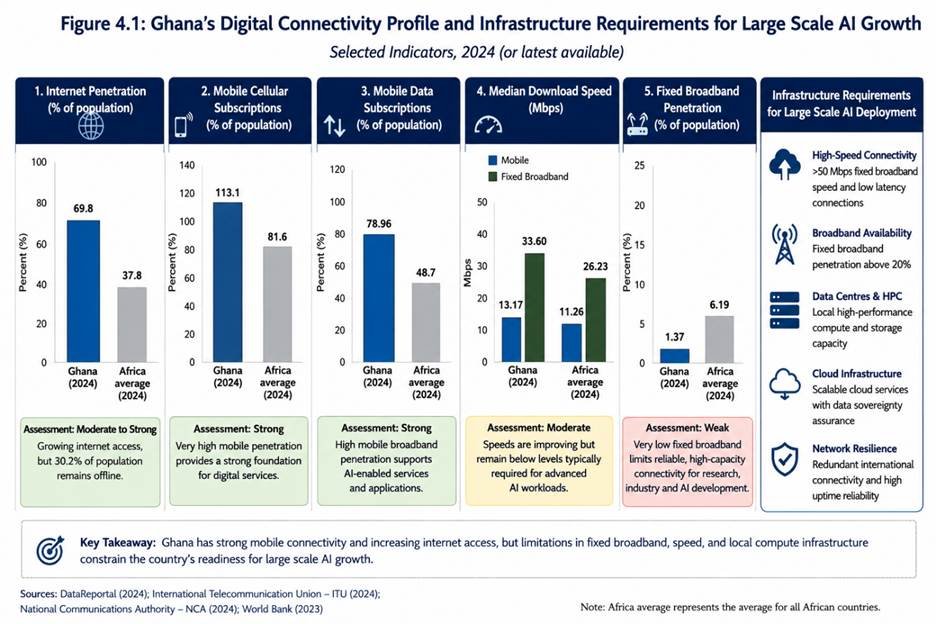
Ghana has made notable progress in expanding digital connectivity over the past decade. According to the 2024 Digital Report for Ghana, the country had approximately 24.06 million Internet users, representing an Internet penetration rate of 69.8 percent of the population. During the same period, Ghana recorded 38.95 million mobile cellular connections, equivalent to 113.1 percent of the national population, reflecting the widespread use of multiple SIM cards and the dominant role of mobile technologies in digital access.
Mobile broadband continues to be the principal means of Internet access in Ghana. The National Communications Authority statistics indicate that mobile data subscriptions will increase to approximately 26.13 million by the end of 2024, corresponding to a mobile data penetration rate of 78.96 percent. This represents a significant recovery following the decline associated with the nationwide SIM registration exercise and demonstrates renewed growth in the digital connectivity.
Internet quality has also improved in recent years. The median mobile download speeds reached 13.17 Mbps, whereas the median fixed broadband speeds increased to 33.60 Mbps in early 2024. Although these improvements enhance access to cloud-based applications and digital services, they remain below the performance levels typically associated with countries that have mature AI ecosystems. Large-scale AI applications, particularly those involving deep learning, computer vision, and large language models, require substantially greater bandwidth, lower latency, and access to high-performance computing resources.
Despite these positive trends, several infrastructural challenges continue to constrain AI readiness. Fixed broadband penetration remains very low compared with mobile Internet usage, limiting the availability of stable, high-capacity Internet connections for research institutions, technology firms, and data-intensive enterprises. Furthermore, local high-performance computing facilities and hyperscale cloud infrastructure remain limited, causing many organizations to depend on international cloud service providers. While this enables access to advanced computing resources, it also raises concerns regarding operational costs, data sovereignty, latency, and long-term digital resilience.
Infrastructure resilience is also an important consideration. The disruption of international submarine cables in 2024 exposed the vulnerability of Ghana’s Internet infrastructure, leading to the temporary degradation of Internet services across the country. This incident highlighted the importance of network redundancy, diversified international connectivity, and resilient digital infrastructure for economies that increasingly depend on digital technologies.
Overall, Ghana demonstrates moderate digital infrastructure readiness for large-scale AI growth. The country possesses strong mobile connectivity and steadily expanding Internet access, providing an important foundation for AI adoption. However, limitations in fixed broadband infrastructure, advanced computing capacity, and locally hosted cloud services indicate that substantial investment will be required before Ghana can fully support widespread AI deployment across the government, industry, and research.
Table 4.1 summarizes the key indicators used to assess Ghana’s digital infrastructure readiness, while Figure 4.1 presents selected digital connectivity indicators in comparison with the requirements for large-scale AI deployment.
Table 4.1: Digital Infrastructure Indicators and Their Implications for AI Readiness in Ghana
| Indicator | Latest Available Value | Assessment | Implication for Large Scale AI Growth |
| Mobile cellular subscriptions | 38.95 million (113.1% of population) | Strong | High mobile penetration provides a broad digital access base but does not directly translate into AI computing capacity. |
| Internet users | 24.06 million (69.8% penetration) | Moderate to Strong | Expanding internet access supports digital inclusion and AI-enabled services, although approximately one-third of the population remains offline. |
| Mobile data subscriptions | 26.13 million (78.96% penetration) | Strong | Mobile broadband is the primary platform for digital services and AI applications, particularly in the fields of finance, commerce, and public services. |
| Median mobile download speed | 13.17 Mbps | Moderate | It is suitable for basic AI-enabled applications but insufficient for bandwidth-intensive AI research and advanced cloud computing. |
| Median fixed broadband speed | 33.60 Mbps | Moderate | Supports enterprise digital services but remains below the capacity generally required for large-scale AI development and high-performance computing. |
| Fixed broadband penetration | Relatively low | Weak | Limited access to reliable high-speed fixed internet constrains research institutions, technology firms, and AI developers. |
| Local data centre capacity | Developing | Moderate | Existing facilities improve digital resilience; however, additional investment is required to support AI model training and large-scale data processing. |
| Cloud computing infrastructure | Predominantly dependent on international providers | Moderate | Access to global cloud platforms enables AI adoption but raises concerns regarding costs, latency, and data sovereignty. |
| Network resilience | Improving but vulnerable to international cable disruptions | Moderate | Infrastructure redundancy is essential for ensuring uninterrupted AI-driven digital services. |
Source: Compiled by the author using data from DataReportal (2024), the International Telecommunication Union (2024), the National Communications Authority (2024), and Freedom House (2024).
Figure 4.1 presents Ghana’s digital connectivity profile, illustrating Internet penetration, mobile subscriptions, mobile broadband subscriptions, and broadband speed indicators relative to the infrastructure requirements for large-scale AI deployment.
4.2 Human Capital and AI Skills
Human capital is one of the most important determinants of artificial intelligence readiness. While digital infrastructure provides the technological foundation for AI deployment, skilled professionals develop algorithms, manage data, build intelligent systems, and maintain AI infrastructure. Countries with a strong pipeline of data scientists, software engineers, machine learning specialists, and AI researchers are generally better positioned to adopt and scale AI technologies across different sectors of the economy (World Economic Forum 2023).
Ghana has made considerable progress in expanding access to tertiary education, particularly in the fields of science, technology, engineering, and mathematics. Universities such as the University of Ghana, Kwame Nkrumah University of Science and Technology, the University of Mines and Technology, and the Academic City University have strengthened their programmes in computer science, software engineering, data science, and related disciplines. These institutions have also established partnerships with international technology companies and research organizations to improve digital skills training and promote innovation in the field.
In recent years, technology companies, including Google, IBM, Microsoft, and Amazon Web Services, have supported digital capacity building through professional certification programmes, cloud computing training, and artificial intelligence workshops across Africa, with Ghana benefiting from several of these initiatives. Local innovation hubs and coding academies have also contributed to the development of digital competencies among young professionals. These efforts have increased awareness of AI technologies and expanded opportunities for practical skill development beyond the traditional university system.
Despite these positive developments, the supply of highly specialized AI professionals remains limited. Most university programmes continue to emphasize general computer science and information technology, while dedicated programmes in machine learning, deep learning, natural language processing, computer vision, and data engineering are still emerging. Consequently, organizations seeking advanced AI expertise often rely on a relatively small pool of professionals or recruit talent from outside the country. This shortage increases labour costs, slows technology adoption, and limits the capacity of local institutions to undertake advanced AI research and development.
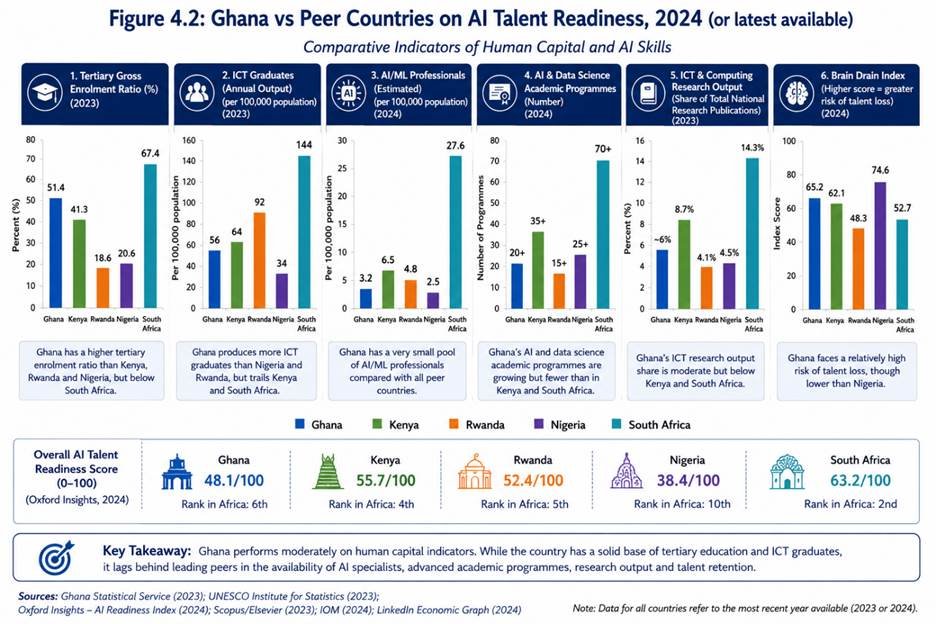
Research capacity also remains an important challenge. Although Ghanaian universities continue to increase research output in computer science and information technology, publications specifically focused on artificial intelligence remain comparatively few when measured against leading African countries such as South Africa and Kenya. Limited funding for research, inadequate access to high performance computing infrastructure, and weak collaboration between academia and industry have constrained the growth of AI research ecosystems. Strengthening these areas will be essential for supporting indigenous AI innovation and reducing dependence on imported technologies.
Another concern is the retention of highly skilled professionals. The global demand for AI specialists has intensified competition for talent, leading many experienced Ghanaian professionals to seek employment abroad or with multinational companies operating outside the country. This migration reduces the availability of experienced researchers, lecturers, and AI practitioners needed to strengthen local institutions. Addressing this challenge requires competitive employment opportunities, sustained investment in research, and stronger collaboration between government, academia, and the private sector.
Notwithstanding these constraints, Ghana possesses several strengths that provide a solid foundation for future AI workforce development. The country’s youthful population, increasing university enrolment, expanding digital literacy programmes, and growing technology ecosystem create favourable conditions for building AI capacity over the long term. National investments in STEM education, digital skills development, and research funding have the potential to significantly improve the country’s readiness for AI driven economic transformation.
Overall, Ghana demonstrates moderate human capital readiness for large scale AI growth. The country has established a growing pipeline of ICT graduates and continues to expand opportunities for digital skills development. However, shortages of specialized AI expertise, limited research capacity, inadequate industry academia collaboration, and challenges in retaining highly skilled professionals continue to constrain the development of a mature AI ecosystem.
Table 4.2 summarizes the key indicators used to assess Ghana’s human capital and AI skills readiness.
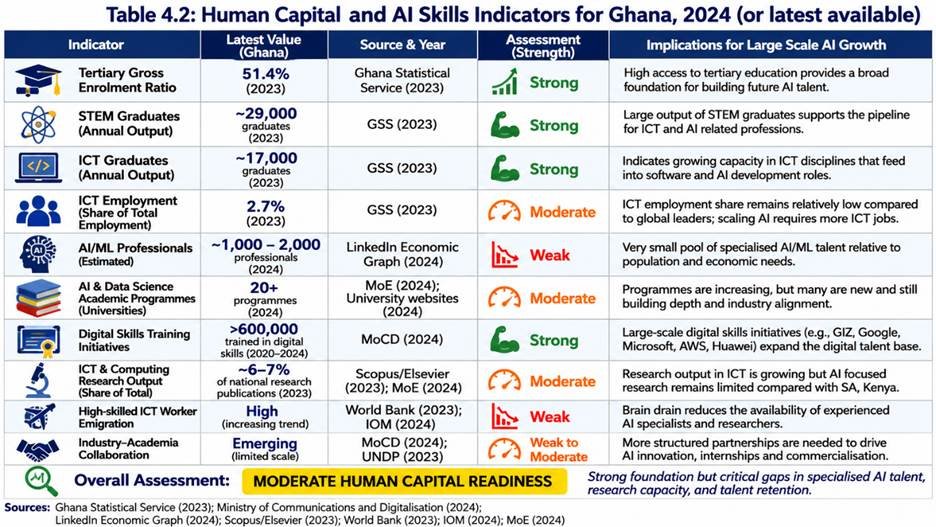
Figure 4.2 compares Ghana’s AI talent ecosystem with selected African countries to provide a broader regional perspective on workforce preparedness for artificial intelligence development.
4.3 Data Ecosystem Readiness
Artificial intelligence relies on the continuous availability of high quality, diverse, and well governed data. Data serve as the foundation for training machine learning models, improving predictive accuracy, and supporting intelligent decision making. Countries with mature data ecosystems are generally better positioned to develop AI applications that are reliable, scalable, and responsive to local needs. Consequently, the strength of a country’s data ecosystem has become an important indicator of AI readiness (OECD, 2024).
Ghana has made steady progress in digitizing information across both the public and private sectors. Government initiatives such as the Ghana Card, the Digital Property Address System, electronic tax administration, digital health records, and mobile money platforms have significantly increased the volume of digital data generated within the country. These initiatives have improved administrative efficiency while creating valuable datasets that can support future AI applications in governance, healthcare, financial services, and urban planning (Ministry of Communications and Digitalisation, 2024).
The financial sector has emerged as one of the largest producers of structured digital data in Ghana. The rapid expansion of mobile money services, digital banking, and electronic payment platforms has generated extensive transaction data that can support fraud detection, credit risk assessment, customer analytics, and financial inclusion initiatives. Similarly, the healthcare and education sectors have accelerated the digitization of records, although the level of implementation varies considerably across institutions and regions (Bank of Ghana, 2024).
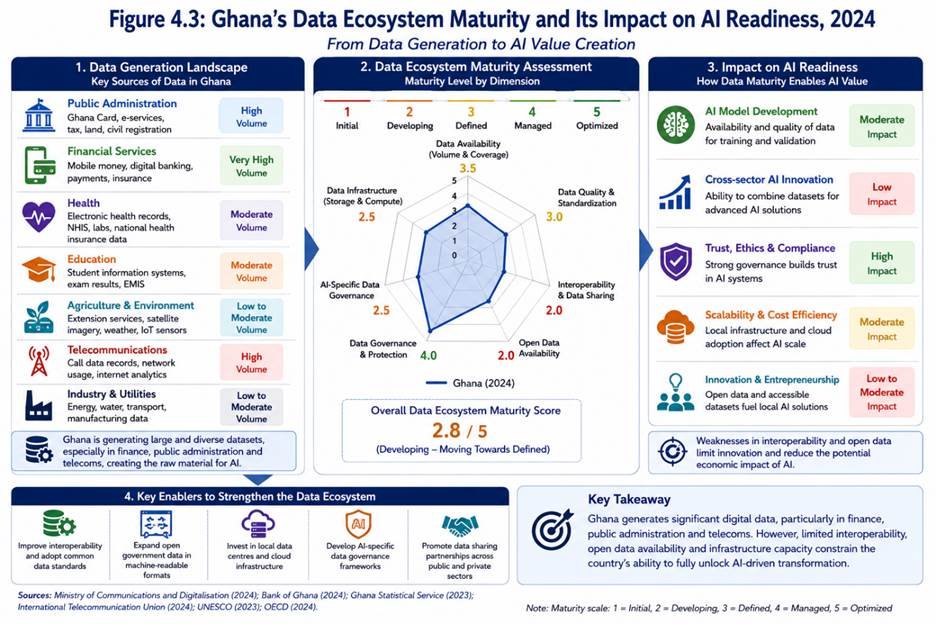
Despite these advances, significant challenges remain regarding data quality, accessibility, and interoperability. Many public institutions continue to operate independent information systems that were developed for specific administrative purposes rather than integrated data sharing. Differences in data standards, inconsistent record keeping practices, and limited interoperability reduce the ability to combine datasets for advanced AI applications. Fragmented information systems also increase the time and cost required to prepare data for machine learning and predictive analytics.
Open data availability remains relatively limited. Although several government agencies publish statistical information and administrative reports, comprehensive, machine readable, and regularly updated datasets are not yet widely available across all sectors. Limited access to open datasets restricts opportunities for researchers, startups, and innovators to develop AI solutions that address local challenges. Expanding open government data initiatives while maintaining appropriate privacy safeguards would significantly strengthen Ghana’s AI ecosystem.
Data governance has improved through the implementation of the Data Protection Act, 2012 (Act 843) and the establishment of the Data Protection Commission. These measures provide an important legal framework for protecting personal information and promoting responsible data management. However, the increasing use of AI introduces additional governance challenges related to algorithmic transparency, data ownership, informed consent, bias mitigation, and accountability. Addressing these issues will require the gradual development of AI specific governance standards that complement existing data protection legislation (UNESCO, 2023).
The growth of cloud computing has also influenced Ghana’s data ecosystem. Many organizations increasingly rely on international cloud service providers to store and process data because of limited local computing infrastructure. While cloud platforms improve scalability and facilitate AI deployment, they also raise concerns regarding cross border data transfers, cybersecurity, regulatory oversight, and digital sovereignty. Expanding local cloud infrastructure and secure national data centres would enhance resilience while supporting domestic AI development.
Overall, Ghana demonstrates moderate data ecosystem readiness for large scale artificial intelligence growth. The country has made substantial progress in digital data generation and data governance, particularly through digital public services and financial technologies. Nevertheless, improvements in data quality, interoperability, open data availability, local data infrastructure, and AI specific governance remain necessary to support the development of sophisticated AI systems.
Table 4.3 summarizes the indicators used to assess Ghana’s data ecosystem readiness, while Figure 4.3 illustrates the relationship between data maturity and AI readiness across the assessment dimensions. The findings presented in this section also provide an important basis for evaluating the country’s innovation ecosystem, which is discussed in the next subsection.
Table 4.3: Data Ecosystem Indicators and Their Implications for AI Readiness in Ghana
| Indicator | Current Status | Assessment | Implication for Large Scale AI Growth |
| Government data digitization | Expanding across public institutions | Moderate to Strong | Digital government initiatives provide increasing volumes of structured data that can support AI applications in public administration and service delivery. |
| Digital financial data | Extensive and continuously growing | Strong | Mobile money, digital banking, and electronic payment systems generate large datasets for AI driven financial analytics, fraud detection, and credit risk modelling. |
| Health and education data digitization | Developing | Moderate | Electronic records are increasing but implementation remains uneven across institutions and regions, limiting nationwide AI applications. |
| Data interoperability | Limited integration among institutional databases | Weak | Fragmented information systems reduce efficient data sharing and hinder AI model development that requires multi sector datasets. |
| Open government data availability | Limited | Weak to Moderate | Restricted access to machine readable public datasets limits research, innovation, and AI solution development by academia and startups. |
| Data quality and standardization | Improving but inconsistent | Moderate | Variations in data quality and standards increase preprocessing requirements and may reduce AI model accuracy. |
| Data protection and privacy framework | Data Protection Act, 2012 (Act 843) and Data Protection Commission in place | Strong | Provides legal safeguards for personal data and establishes an important foundation for responsible AI development. |
| AI specific data governance | Emerging | Moderate | AI governance policies addressing algorithmic accountability, fairness, explainability, and ethical data use are still evolving. |
| Cloud based data storage | Increasing adoption of international cloud platforms | Moderate | Improves scalability for AI applications but raises concerns regarding data sovereignty, cybersecurity, and operational costs. |
| Local data centre capacity | Growing but limited | Moderate | Additional investment is needed to support large scale AI training, secure data storage, and high performance computing. |
4.4 Innovation and Industry Readiness
Innovation is a critical driver of artificial intelligence development because it transforms research, technical knowledge, and digital infrastructure into practical solutions that address economic and societal challenges. A country’s AI readiness depends not only on the availability of technology but also on its ability to foster entrepreneurship, encourage research, attract investment, and promote collaboration among government, academia, and industry. Strong innovation ecosystems accelerate the development, testing, commercialization, and adoption of AI technologies across multiple sectors (OECD, 2024).
Ghana’s innovation ecosystem has expanded considerably over the past decade. The country has witnessed the growth of technology hubs, startup incubators, accelerators, and entrepreneurship programmes that support digital innovation. Organizations such as MEST Africa, Impact Hub Accra, and other innovation centres have provided mentoring, seed funding, and technical support to entrepreneurs developing digital solutions in agriculture, healthcare, financial services, education, logistics, and electronic commerce. These initiatives have strengthened the country’s entrepreneurial culture and increased opportunities for technology driven business development.
The financial technology industry remains one of Ghana’s strongest innovation sectors. Fintech companies continue to develop digital payment platforms, lending solutions, insurance technologies, and financial management applications that improve financial inclusion and business efficiency. According to the Bank of Ghana (2024), the rapid growth of digital financial services demonstrates the country’s capacity to adopt technology based innovations that can later serve as platforms for AI enabled products and services.
Research institutions and universities have also contributed to the country’s innovation landscape. Universities increasingly support research in computer science, robotics, data analytics, and artificial intelligence through specialized laboratories and collaborative projects. Partnerships with international universities and technology companies have expanded opportunities for knowledge exchange and capacity building. Nevertheless, AI specific research output remains relatively modest when compared with leading African countries such as South Africa and Kenya, reflecting differences in research funding, laboratory infrastructure, and access to advanced computing resources (Maslej et al., 2024).
Despite these positive developments, commercialization of research remains limited. Many innovative ideas developed within universities do not progress beyond the prototype stage because of insufficient venture capital, limited technology transfer mechanisms, and weak collaboration between researchers and industry. Small and medium sized enterprises also face challenges in adopting AI technologies because of high implementation costs, limited technical expertise, and uncertainty regarding return on investment.
Investment in AI focused innovation remains relatively low. Although Ghana continues to attract investment into digital entrepreneurship and financial technology, dedicated funding for AI research, deep technology startups, and advanced digital infrastructure is still developing. The absence of large scale venture capital funds specializing in AI reduces opportunities for local entrepreneurs to build globally competitive AI solutions. Increased investment from both public and private sectors will be essential to accelerate AI commercialization and strengthen national competitiveness.
Industry adoption of AI is gradually increasing across sectors such as banking, telecommunications, healthcare, agriculture, manufacturing, and retail. Organizations are beginning to use AI for customer service automation, fraud detection, predictive analytics, precision agriculture, demand forecasting, and business intelligence. However, adoption remains concentrated among larger organizations with sufficient financial and technical resources. Many small and medium sized enterprises continue to face barriers related to cost, infrastructure, digital skills, and data availability.
Collaboration among government, academia, and industry has improved through various digital innovation initiatives, but stronger institutional partnerships are still required to build a sustainable AI ecosystem. Effective collaboration facilitates knowledge transfer, promotes applied research, supports commercialization, and ensures that AI solutions respond to national development priorities. Strengthening these partnerships will help bridge the gap between academic research and industrial application.
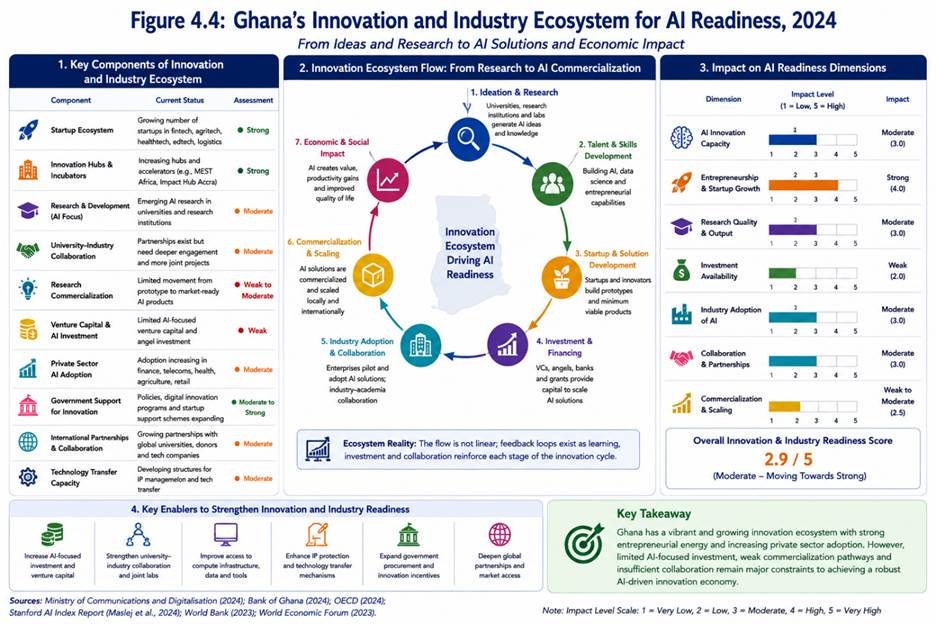
Overall, Ghana demonstrates moderate innovation and industry readiness for large scale artificial intelligence growth. The country has developed a vibrant startup ecosystem and continues to strengthen entrepreneurship and digital innovation. However, limited AI focused investment, relatively low research commercialization, insufficient venture capital, and weak industry academia collaboration continue to constrain the development of a mature AI innovation ecosystem.
Table 4.4: Innovation and Industry Indicators and Their Implications for AI Readiness in Ghana
| Indicator | Current Status | Assessment | Implication for Large Scale AI Growth |
| Technology startup ecosystem | Expanding, particularly in Accra and Kumasi | Strong | A growing startup ecosystem provides opportunities for AI innovation, entrepreneurship, and technology commercialization. |
| Innovation hubs and incubators | Increasing number of technology hubs and business accelerators | Strong | Innovation hubs promote AI experimentation, startup development, and digital skills acquisition. |
| AI research output | Emerging but relatively limited | Moderate | Increasing AI research contributes to knowledge creation but remains below leading African AI ecosystems. |
| University–industry collaboration | Developing | Moderate | Existing partnerships support research and innovation, but stronger collaboration is required to accelerate AI commercialization. |
| Research commercialization | Limited | Weak to Moderate | Many research outcomes do not progress to market ready AI products because of weak technology transfer mechanisms. |
| Venture capital and AI investment | Limited availability of AI focused funding | Weak | Insufficient investment constrains startup growth, AI research, and commercialization of innovative solutions. |
| Private sector AI adoption | Gradually increasing across finance, telecommunications, healthcare, agriculture, and retail | Moderate | Growing enterprise adoption demonstrates market demand but remains concentrated among large organizations. |
| Government support for innovation | Digital innovation policies and entrepreneurship programmes expanding | Moderate to Strong | Public sector initiatives provide a favourable environment for digital innovation and AI ecosystem development. |
| International research and technology partnerships | Increasing collaboration with global universities and technology companies | Moderate | International partnerships strengthen knowledge exchange, skills development, and access to emerging AI technologies. |
| Technology transfer capacity | Developing | Moderate | Improved mechanisms are required to convert research findings into commercially viable AI products and services. |
4.5 Governance and Institutional Readiness
Governance plays a central role in the responsible development and deployment of artificial intelligence. Effective governance provides the legal, ethical, and institutional foundations needed to ensure that AI systems are transparent, accountable, secure, and aligned with national development objectives. It also promotes public trust by establishing safeguards for data privacy, cybersecurity, fairness, and human rights. As AI technologies become increasingly integrated into economic and public sector activities, governance has become an essential component of national AI readiness (UNESCO, 2023).
Ghana has made significant progress in developing the legal and institutional framework that supports digital transformation. The country has enacted several laws and policies that promote secure digital services, electronic transactions, data protection, and cybersecurity. Notable examples include the Data Protection Act, 2012 (Act 843), the Cybersecurity Act, 2020 (Act 1038), and the Electronic Transactions Act, 2008 (Act 772). Together, these legal instruments provide an important regulatory foundation for the country’s expanding digital economy and the future adoption of AI technologies.
Institutional development has also strengthened Ghana’s digital governance landscape. The establishment of the Data Protection Commission, the Cyber Security Authority, and the continued leadership of the Ministry of Communications and Digitalisation have improved coordination in areas such as digital policy implementation, cybersecurity regulation, and personal data protection. These institutions continue to play important roles in promoting digital trust and supporting the country’s broader digital transformation agenda.
Despite these achievements, Ghana does not yet have a comprehensive national artificial intelligence strategy that provides a coordinated framework for AI research, development, deployment, regulation, and investment. Existing digital policies acknowledge the growing importance of AI, but they do not comprehensively address issues such as algorithmic accountability, explainability, ethical AI, risk management, intellectual property in AI generated content, or governance of foundation models. The absence of a dedicated AI strategy may reduce policy coherence as AI adoption accelerates across sectors.
Institutional coordination also presents important challenges. AI governance requires collaboration among government ministries, regulatory agencies, universities, research institutions, industry, and civil society organizations. Although these stakeholders increasingly participate in digital transformation initiatives, coordination mechanisms specifically focused on AI remain limited. Greater collaboration would support the development of harmonized standards, shared research priorities, and coordinated implementation of AI policies.
Cybersecurity readiness represents another important aspect of AI governance. AI systems depend on secure digital infrastructure and trusted data environments. Ghana has strengthened its national cybersecurity framework through legislation, institutional reforms, and public awareness programmes. Nevertheless, increasing cyber threats, ransomware attacks, and digital fraud continue to pose risks to AI enabled systems, particularly as organizations become more dependent on cloud computing and interconnected digital platforms. Continued investment in cybersecurity capacity will therefore remain essential for sustaining AI growth.
International cooperation is becoming increasingly important for AI governance. Ghana actively participates in regional and international digital policy discussions through organizations such as the African Union, the International Telecommunication Union, and the United Nations. These engagements provide opportunities to align national policies with emerging international principles on responsible AI, ethics, interoperability, and digital governance. They also facilitate knowledge sharing and technical assistance that can strengthen national institutional capacity.
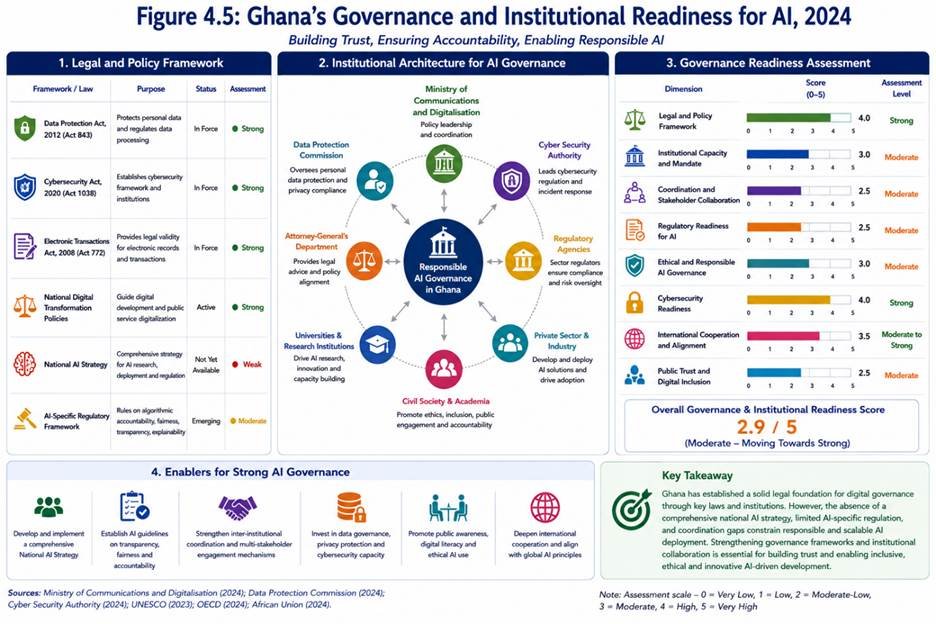
Overall, Ghana demonstrates moderate governance and institutional readiness for large scale artificial intelligence growth. The country possesses a relatively strong legal foundation for digital governance and continues to strengthen institutional capacity in data protection and cybersecurity. However, the absence of a comprehensive national AI strategy, evolving AI specific regulatory frameworks, and limited institutional coordination remain important constraints that should be addressed to support responsible and sustainable AI adoption.
Table 4.5 summarizes the governance and institutional indicators used in this assessment, while Figure 4.5 illustrates the relationship between legal frameworks, institutional capacity, regulatory readiness, and responsible AI deployment in Ghana.
Table 4.5: Governance and Institutional Indicators and Their Implications for AI Readiness in Ghana
| Indicator | Current Status | Assessment | Implication for Large Scale AI Growth |
| National digital governance framework | Well established through national digital transformation policies | Strong | Provides a strategic foundation for digital transformation and creates an enabling environment for AI adoption. |
| Data protection legislation | Data Protection Act, 2012 (Act 843) in force | Strong | Protects personal data and promotes responsible data management, which is essential for trustworthy AI systems. |
| Cybersecurity framework | Cybersecurity Act, 2020 (Act 1038) and Cyber Security Authority operational | Strong | Strengthens digital resilience and protects AI systems from cyber threats and malicious attacks. |
| Electronic transactions framework | Electronic Transactions Act, 2008 (Act 772) implemented | Strong | Facilitates secure electronic transactions and supports AI-enabled digital services and e-commerce. |
| National AI strategy | No comprehensive standalone national AI strategy | Weak | The absence of a dedicated AI strategy limits coordinated planning, investment, and regulation for AI development. |
| AI-specific regulatory framework | Emerging | Moderate | AI governance principles relating to transparency, accountability, fairness, and explainability are still under development. |
| Institutional coordination | Multiple institutions involved but coordination remains limited | Moderate | Improved collaboration among government, academia, industry, and regulators is needed for effective AI governance. |
| Ethical AI governance | Developing | Moderate | Greater emphasis is required on responsible AI, algorithmic fairness, human oversight, and ethical risk management. |
| International cooperation | Active participation in regional and global digital initiatives | Moderate to Strong | International partnerships facilitate knowledge sharing, policy harmonization, and capacity building for AI governance. |
| Public trust and digital inclusion | Improving through digital public services and awareness initiatives | Moderate | Increased public confidence and digital literacy will encourage broader adoption of AI-enabled services. |
5.0 Discussion
The findings of this study indicate that Ghana has established many of the foundational elements required to support artificial intelligence driven development. Progress in digital transformation, expanding internet access, increasing mobile connectivity, growth in financial technology, and improvements in digital public services demonstrate a clear national commitment to building a digital economy. These achievements provide a favourable environment for introducing AI applications across sectors such as healthcare, agriculture, education, financial services, manufacturing, and public administration. Nevertheless, the assessment also shows that important structural constraints continue to limit the country’s preparedness for large scale AI deployment.
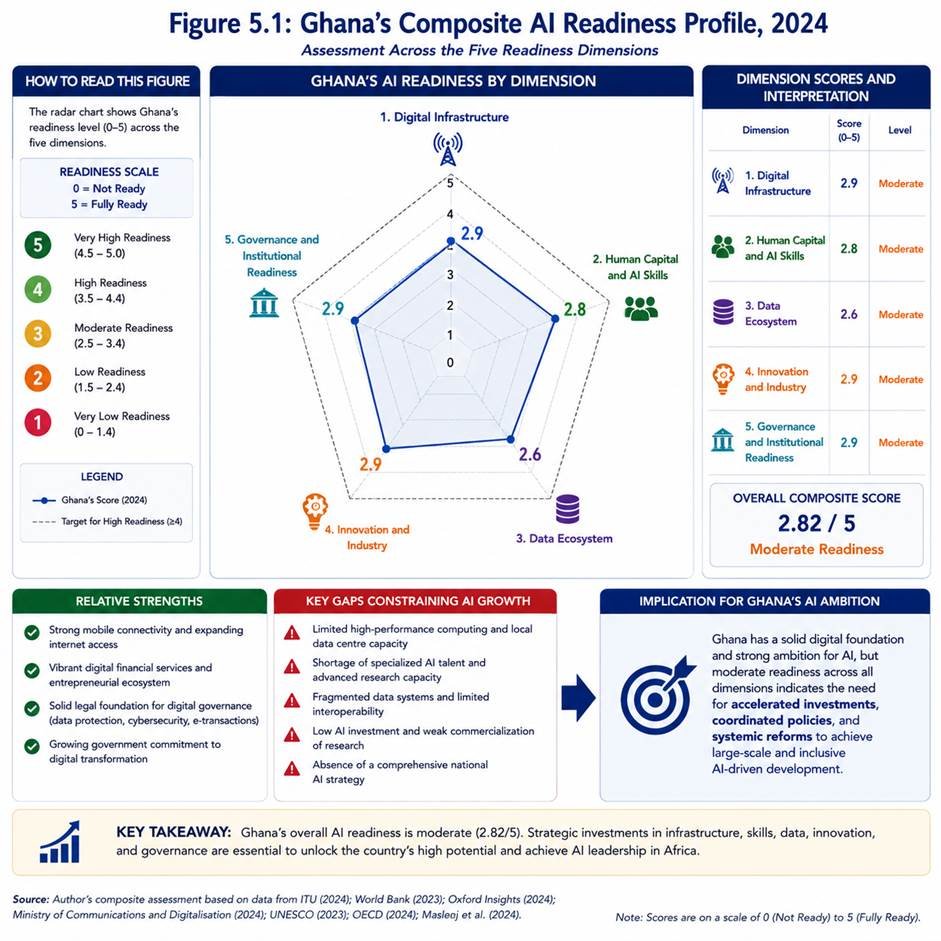
Across the five readiness dimensions, Ghana demonstrates moderate overall readiness for artificial intelligence growth. Digital infrastructure has improved considerably through increased mobile broadband coverage and expanding internet penetration. However, limited fixed broadband infrastructure, insufficient high performance computing resources, and continued dependence on international cloud providers constrain the country’s capacity to develop and deploy computationally intensive AI systems. Similar observations have been reported in global AI readiness studies, which emphasize that widespread internet access alone is insufficient for sustaining advanced AI ecosystems (International Telecommunication Union, 2024; Oxford Insights, 2024).
Human capital remains one of the most significant challenges identified in this assessment. Although Ghana continues to produce increasing numbers of graduates in science, technology, engineering, and mathematics, the supply of specialists in artificial intelligence, machine learning, data engineering, and advanced analytics remains inadequate to meet current and future demand. The shortage of highly specialized professionals is compounded by limited postgraduate AI programmes, relatively low research funding, and the migration of experienced digital professionals to international labour markets. These findings are consistent with previous studies that identify skilled human resources as one of the principal determinants of national AI competitiveness (World Economic Forum, 2023; Maslej et al., 2024).
The assessment further demonstrates that Ghana’s data ecosystem is evolving but remains fragmented. Government digitalization initiatives and the rapid growth of digital financial services have significantly increased the availability of digital data. However, limited interoperability among institutional databases, inconsistent data standards, and restricted access to open government data continue to reduce opportunities for developing sophisticated AI applications. Since AI systems depend on large volumes of reliable and representative data, strengthening national data governance and promoting secure data sharing should become strategic priorities for future digital transformation.
Innovation and entrepreneurship constitute one of Ghana’s strongest comparative advantages. The country has developed a vibrant startup ecosystem supported by innovation hubs, business incubators, universities, and technology entrepreneurs. Digital financial services demonstrate the ability of Ghanaian innovators to develop scalable technology solutions with national impact. Despite this progress, AI commercialization remains relatively limited because of inadequate venture capital, insufficient investment in advanced research, weak technology transfer mechanisms, and limited collaboration between academia and industry. Addressing these barriers would improve the translation of research into market ready AI products and services.
The governance assessment presents a similarly balanced picture. Ghana has established an important legal foundation through legislation on data protection, cybersecurity, and electronic transactions. These frameworks provide an enabling environment for secure digital transformation and responsible data management. However, the absence of a comprehensive national artificial intelligence strategy remains a significant policy gap. As AI technologies become more integrated into public administration and private enterprise, Ghana will require dedicated governance mechanisms that address ethical AI, algorithmic transparency, accountability, risk management, intellectual property, and regulatory oversight. International organizations increasingly recommend the adoption of AI specific governance frameworks that complement existing digital legislation while promoting responsible innovation (UNESCO, 2023; OECD, 2024).
When compared with selected African countries, Ghana occupies an intermediate position in AI readiness. South Africa continues to lead the continent in AI research, advanced computing infrastructure, and research commercialization. Kenya has established a dynamic digital innovation ecosystem supported by strong startup activity and growing AI investment. Rwanda has distinguished itself through coordinated digital governance and long term investment in digital public infrastructure. Nigeria benefits from a large technology market, expanding venture capital, and a rapidly growing pool of digital entrepreneurs. Ghana compares favourably in digital financial services, digital governance, and political stability, but trails these countries in specialized AI talent, research intensity, computing infrastructure, and AI focused investment. This comparison suggests that Ghana possesses a solid digital foundation but must accelerate investment in advanced AI capabilities if it is to compete effectively within Africa’s emerging AI economy.
Overall, the findings support the central argument of this paper that AI ambition currently exceeds ICT readiness in Ghana. National policy commitments, digital transformation initiatives, and increasing awareness of artificial intelligence demonstrate strong ambition. However, achieving sustainable and inclusive AI growth will require substantial improvements in infrastructure, advanced technical skills, research capacity, innovation financing, data maturity, and AI governance. These dimensions are highly interconnected, meaning that progress in one area is unlikely to produce meaningful AI transformation without complementary investments in the others.
Table 5.1 summarizes the overall assessment across the five readiness dimensions, while Figure 5.1 presents Ghana’s composite AI readiness profile, illustrating the relative strengths and weaknesses identified in this study. These findings provide the basis for the policy implications and recommendations presented in the next section.
Table 5.1: Summary of Ghana’s ICT Sector Readiness for Large Scale Artificial Intelligence Growth
| Readiness Dimension | Key Strengths | Key Challenges | Overall Readiness Level |
| Digital Infrastructure | High mobile penetration, expanding internet access, growing broadband coverage, improving digital connectivity | Low fixed broadband penetration, limited high performance computing infrastructure, dependence on international cloud services, network resilience concerns | Moderate |
| Human Capital and AI Skills | Growing STEM enrolment, expanding ICT programmes, increasing digital skills initiatives, active technology training programmes | Shortage of AI specialists, limited postgraduate AI programmes, inadequate research funding, brain drain of highly skilled professionals | Moderate |
| Data Ecosystem | Increasing digital government services, expanding digital financial data, improved legal framework for data protection | Fragmented data systems, weak interoperability, limited open data availability, evolving AI specific data governance | Moderate |
| Innovation and Industry | Vibrant startup ecosystem, expanding innovation hubs, strong fintech sector, growing digital entrepreneurship | Limited AI research commercialization, inadequate venture capital, weak university–industry collaboration, low AI focused investment | Moderate |
| Governance and Institutional Readiness | Strong digital governance laws, operational cybersecurity and data protection institutions, commitment to digital transformation | No comprehensive national AI strategy, emerging AI regulations, limited institutional coordination for AI governance | Moderate |
Key Interpretation
The assessment indicates that Ghana possesses a strong digital transformation foundation but has not yet reached the level of ICT maturity required for widespread and sustainable artificial intelligence deployment. Progress has been most visible in digital connectivity, fintech innovation, and digital governance. However, significant investments are still required in advanced digital infrastructure, AI talent development, research commercialization, data ecosystem integration, and AI specific governance. Addressing these gaps will be critical for translating national AI ambition into practical and sustainable implementation.
Source: Author’s synthesis based on the analyses presented in Sections 4.1–4.5 using data from the International Telecommunication Union (2024), World Bank (2023), Oxford Insights (2024), Ministry of Communications and Digitalisation (2024), Bank of Ghana (2024), Ghana Statistical Service (2023), UNESCO (2023), OECD (2024), and Maslej et al. (2024).
6.0 Policy Implications and Recommendations
The findings of this study have important implications for Ghana’s digital transformation agenda and its ambition to become a competitive participant in the global artificial intelligence ecosystem. Although the country has made notable progress in ICT development, the assessment shows that existing infrastructure, human capital, innovation systems, and governance arrangements require further strengthening before AI can be deployed at scale. Addressing these gaps will require coordinated action by government, academia, industry, development partners, and civil society.
6.1 Strengthen Digital Infrastructure
Reliable digital infrastructure should remain a national priority. Continued investment is needed to expand high speed broadband networks, improve fixed broadband penetration, and increase access to affordable internet services across both urban and rural communities. Government should also encourage investment in local data centres, cloud computing infrastructure, and high performance computing facilities to reduce dependence on foreign platforms and improve national digital resilience. Strengthening network redundancy and international connectivity will further improve the reliability of digital services that support AI applications.
6.2 Develop Advanced AI Human Capital
Ghana should move beyond general ICT education by investing in specialized AI capacity development. Universities should introduce additional undergraduate and postgraduate programmes in artificial intelligence, machine learning, robotics, data engineering, and cloud computing. Greater collaboration between higher education institutions and industry will help align curricula with labour market needs while increasing opportunities for internships, research projects, and professional certification. Government scholarship schemes and competitive research grants should also support the development of future AI researchers and practitioners.
6.3 Build a National Data Ecosystem
The successful deployment of AI requires reliable, accessible, and interoperable data. Government institutions should accelerate the integration of public information systems through common data standards and secure data sharing mechanisms. Open government data initiatives should be expanded to provide researchers and innovators with greater access to non sensitive datasets while maintaining appropriate privacy safeguards. Investment in data quality management, metadata standards, and secure digital repositories will improve the effectiveness of AI applications across multiple sectors.
6.4 Strengthen Innovation and AI Commercialization
Innovation policies should place greater emphasis on AI research and commercialization. Dedicated funding programmes for AI startups, university research laboratories, and technology transfer initiatives would encourage the development of locally relevant AI solutions. Government and private investors should establish venture capital mechanisms that support deep technology enterprises and facilitate the transition of research outputs into commercial products. Public procurement policies can also stimulate AI innovation by creating opportunities for local companies to develop solutions that address national development challenges.
6.5 Establish a Comprehensive National AI Governance Framework
Ghana should develop a comprehensive national artificial intelligence strategy that provides a clear vision for AI research, innovation, investment, regulation, and ethical governance. The strategy should define institutional responsibilities, establish implementation priorities, and include mechanisms for monitoring progress. AI governance should incorporate principles of transparency, accountability, fairness, privacy, human oversight, and cybersecurity while remaining consistent with international standards and national development objectives.
6.6 Promote Multi Stakeholder Collaboration
Artificial intelligence development requires sustained collaboration among government agencies, universities, research institutions, technology companies, professional associations, and civil society organizations. National AI platforms should be established to facilitate knowledge exchange, joint research, policy dialogue, and innovation partnerships. International cooperation with regional and global organizations should also be strengthened to improve access to expertise, funding opportunities, and emerging best practices.
6.7 Establish a National AI Readiness Monitoring Framework
AI readiness should be treated as a continuous process rather than a one time assessment. Government should develop a national monitoring framework with measurable indicators covering infrastructure, digital skills, research output, innovation, governance, and AI adoption. Regular publication of AI readiness reports would enable policymakers to evaluate progress, identify emerging gaps, and adjust national strategies in response to technological developments.
The implementation of these recommendations would strengthen Ghana’s capacity to move from digital transformation to AI driven development. More importantly, they would help bridge the gap identified throughout this study between national AI ambition and the current reality of the country’s ICT sector. However, achieving these outcomes will require sustained political commitment, long term investment, and effective coordination among all stakeholders.
Table 6.1 summarizes the key policy recommendations, responsible stakeholders, and expected outcomes arising from this study. The following section considers future directions for research and national AI development.
Table 6.1: Policy Recommendations for Strengthening Ghana’s AI Readiness
| Strategic Area | Key Recommendation | Lead Stakeholders | Expected Outcome |
| Digital Infrastructure | Expand nationwide high-speed broadband, strengthen fixed broadband networks, invest in local data centres, cloud infrastructure, and high-performance computing facilities. | Ministry of Communications and Digitalisation, National Communications Authority, private telecommunications operators, cloud service providers | Improved digital infrastructure capable of supporting large scale AI development and deployment. |
| Human Capital and AI Skills | Introduce specialized AI degree programmes, strengthen STEM education, expand AI certification programmes, and provide research scholarships and professional training. | Ministry of Education, Ghana Tertiary Education Commission, universities, technical universities, private technology companies | Increased availability of AI specialists, data scientists, machine learning engineers, and digital innovation professionals. |
| Data Ecosystem | Develop interoperable government information systems, improve data quality standards, expand open government data initiatives, and strengthen secure data sharing mechanisms. | Ministry of Communications and Digitalisation, Data Protection Commission, Ghana Statistical Service, public sector institutions | Improved availability, quality, and accessibility of data for AI research and intelligent decision making. |
| Innovation and Industry | Increase funding for AI research, establish AI innovation funds, strengthen technology transfer offices, and expand venture capital support for AI startups. | Government of Ghana, universities, venture capital firms, development partners, private investors | Increased commercialization of AI research, stronger startup ecosystem, and greater private sector AI adoption. |
| Governance and Regulation | Develop and implement a comprehensive National Artificial Intelligence Strategy supported by AI specific regulatory and ethical guidelines. | Ministry of Communications and Digitalisation, Parliament, Data Protection Commission, Cyber Security Authority, Attorney General’s Department | Coordinated AI governance that promotes responsible, transparent, and secure AI development. |
| Research and Academia | Strengthen AI research laboratories, encourage multidisciplinary AI research, and promote international research collaboration. | Universities, research institutes, international development partners | Improved AI research capacity, increased scientific publications, and stronger innovation ecosystems. |
| Industry–Academia Collaboration | Establish collaborative research centres, industry internships, innovation partnerships, and joint AI development programmes. | Universities, technology companies, business associations, innovation hubs | Faster translation of research into commercially viable AI products and services. |
| Investment and Financing | Create incentives for AI investment through grants, tax incentives, public procurement, and dedicated AI venture funds. | Ministry of Finance, Ghana Investment Promotion Centre, development finance institutions, private investors | Increased domestic and foreign investment in AI innovation and digital technology enterprises. |
| International Cooperation | Expand partnerships with regional and global AI initiatives to support technology transfer, policy learning, and capacity building. | African Union, ECOWAS, UNESCO, ITU, OECD, development partners | Greater access to international expertise, funding opportunities, and AI best practices. |
| Monitoring and Evaluation | Establish a National AI Readiness Monitoring Framework with periodic assessments and measurable performance indicators. | Ministry of Communications and Digitalisation, Ghana Statistical Service, research institutions | Continuous monitoring of AI readiness and evidence based policy adjustments. |
Expected National Impact
Implementation of these recommendations is expected to strengthen Ghana’s ICT ecosystem, accelerate responsible AI adoption, improve digital competitiveness, stimulate innovation, enhance public service delivery, and position the country as one of the emerging AI economies in Africa.
Source: Developed by the author based on the findings of this study and informed by recommendations from the International Telecommunication Union (2024), UNESCO (2023), OECD (2024), World Bank (2023), Oxford Insights (2024), and the African Union (2024).
7.0 Future Directions
Artificial intelligence is evolving rapidly, and national AI readiness should be viewed as a continuous process rather than a fixed achievement. As digital technologies become more sophisticated and AI applications expand across sectors, Ghana must continuously strengthen its ICT ecosystem to remain competitive. The findings of this study suggest that while the country has established an encouraging digital foundation, sustained investment and long-term planning will be necessary to transform current AI ambitions into measurable socioeconomic outcomes.
One important priority is the development of a comprehensive national artificial intelligence strategy. Such a strategy should provide a long-term vision for AI research, innovation, governance, infrastructure, investment, and workforce development. It should also establish measurable national targets, define institutional responsibilities, and create mechanisms for monitoring implementation. Aligning this strategy with Ghana’s broader digital transformation agenda and national development priorities will improve policy coherence and facilitate coordinated implementation across government institutions.
Future investments should also focus on expanding advanced digital infrastructure. Although mobile connectivity and internet access have improved considerably, greater emphasis should be placed on high-performance computing facilities, cloud infrastructure, local data centres, and resilient broadband networks. These investments will not only support AI development but will also strengthen Ghana’s broader digital economy by improving cybersecurity, data resilience, and digital service delivery.
Developing a highly skilled AI workforce will remain essential for sustaining long-term competitiveness. Universities should continue expanding postgraduate programmes in artificial intelligence, machine learning, robotics, data science, and cloud computing while strengthening collaboration with industry. Professional certification programmes, lifelong digital learning initiatives, and industry-based training will also help prepare the existing workforce for the increasing adoption of AI technologies across different sectors of the economy.
Future research should extend beyond national readiness assessments by examining sector-specific AI adoption within healthcare, agriculture, education, manufacturing, financial services, transportation, and public administration. Such studies would provide a deeper understanding of the opportunities, constraints, and policy requirements associated with AI implementation in individual sectors. Longitudinal studies that monitor changes in Ghana’s AI readiness over time would also provide valuable evidence for evaluating the effectiveness of national digital transformation policies.
Comparative studies involving other African countries should receive greater attention. Examining Ghana alongside countries such as Kenya, Rwanda, Nigeria, South Africa, Egypt, and Morocco would generate valuable insights into effective policy approaches, investment strategies, and institutional arrangements that promote successful AI ecosystems. Regional collaboration within the framework of the African Union and the African Continental Free Trade Area could also support knowledge sharing, research partnerships, and the development of harmonized AI governance principles across the continent.
Emerging technologies will further shape Ghana’s future AI landscape. Advances in generative AI, edge computing, quantum computing, the Internet of Things, robotics, and intelligent automation are expected to create new opportunities while introducing additional regulatory and ethical challenges. Policymakers, researchers, and industry leaders should therefore maintain flexible governance frameworks that encourage innovation while protecting privacy, security, fairness, and public trust.
Finally, future AI development in Ghana should be guided by the principles of inclusiveness, sustainability, and responsible innovation. AI should contribute to reducing social and regional inequalities rather than widening them. Particular attention should be given to expanding digital access in underserved communities, promoting gender inclusion in AI education and employment, supporting local language technologies, and ensuring that AI applications respond to Ghana’s development priorities. These principles will help ensure that AI becomes a tool for broad-based national development rather than a technology that benefits only a limited segment of society.
Figure 7.1 presents a proposed roadmap for Ghana’s AI development over the next decade, highlighting the strategic actions required to progress from moderate AI readiness to a mature and globally competitive AI ecosystem.
8.0 Conclusion
This study assessed Ghana’s ICT sector readiness for large scale artificial intelligence growth by examining five critical dimensions, namely digital infrastructure, human capital and AI skills, data ecosystem readiness, innovation and industry readiness, and governance and institutional readiness. Using a qualitative desk based research approach supported by recent national and international evidence, the study evaluated the extent to which Ghana’s current ICT ecosystem can support the country’s growing ambitions for AI driven development.
The findings indicate that Ghana has made substantial progress in digital transformation over the past decade. Improvements in mobile connectivity, internet access, digital public services, financial technology, and digital governance have created a strong foundation for future AI adoption. Government commitment to digitalization, together with the emergence of technology startups, innovation hubs, and expanding ICT education, demonstrates that the country possesses many of the essential building blocks needed for an AI enabled economy.
Despite these achievements, the assessment also reveals that Ghana’s ICT ecosystem has not yet reached the level of maturity required to support widespread and sustainable AI deployment. Constraints remain in advanced digital infrastructure, high performance computing, AI specific technical skills, research capacity, data interoperability, commercialization of innovation, and comprehensive AI governance. These challenges suggest that while national ambition for AI is high, the supporting ICT environment is still developing.
The study therefore supports the central proposition that Ghana’s AI ambition currently exceeds its ICT reality. This does not imply that the country is unprepared for artificial intelligence. Rather, it indicates that significant investments and coordinated policy interventions are still required before AI can be deployed at scale across government, industry, healthcare, agriculture, education, and other strategic sectors. Closing this gap will require long term commitment, sustained financing, and effective collaboration among public institutions, academia, industry, development partners, and civil society.
One of the principal contributions of this study is the development of a multidimensional framework for assessing AI readiness within the context of a developing economy. By integrating evidence across infrastructure, skills, data, innovation, and governance, the study provides a comprehensive understanding of the factors that influence national AI preparedness. The findings also offer an evidence-based foundation for policymakers seeking to align Ghana’s digital transformation agenda with emerging opportunities in artificial intelligence.
The study concludes that Ghana possesses considerable potential to become one of Africa’s leading AI enabled economies if current digital transformation efforts are complemented by targeted investments in advanced infrastructure, specialized human capital, research and innovation, data ecosystems, and responsible AI governance. Progress in these areas will strengthen national competitiveness, stimulate economic diversification, improve public service delivery, and enhance resilience within an increasingly digital global economy.
Ultimately, the future of artificial intelligence in Ghana will depend not only on technological advancement but also on the country’s ability to translate policy ambition into practical implementation. A strategic, inclusive, and well coordinated approach to AI development will enable Ghana to harness the transformative potential of artificial intelligence while ensuring that its benefits contribute to sustainable economic growth, social inclusion, and national development.
References
African Union. (2024). Continental artificial intelligence strategy for Africa.
Bank of Ghana. (2024). Payment systems oversight annual report 2024. Bank of Ghana.
DataReportal. (2024). Digital 2024: Ghana. Kepios. https://datareportal.com/reports/digital-2024-ghana
Freedom House. (2024). Freedom on the Net 2024: Ghana. Freedom House. https://freedomhouse.org/country/ghana/freedom-net/2024
Ghana Statistical Service. (2023). 2023 population and housing census: Information and communication technology (ICT) analytical report. Ghana Statistical Service.
International Monetary Fund. (2024). Gen-AI: Artificial intelligence and the future of work (Staff Discussion Note SDN/2024/001). International Monetary Fund.
International Telecommunication Union. (2024). AI readiness enablers: Introduction and guide. International Telecommunication Union.
International Telecommunication Union. (2024). Measuring digital development: ICT Development Index 2024. International Telecommunication Union.
Maslej, N., Fattorini, L., Perrault, R., Parli, V., Reuel, A., Brynjolfsson, E., Etchemendy, J., Ligett, K., Lyons, T., Manyika, J., Niebles, J. C., Shoham, Y., Wald, R., & Clark, J. (2024). Artificial intelligence index report 2024. Stanford Institute for Human-Centered Artificial Intelligence, Stanford University.
Ministry of Communications and Digitalisation. (2024). Ghana digital economy policy and strategy. Government of Ghana.
National Communications Authority. (2024). Communications industry report: End of year statistical bulletin 2024. National Communications Authority.
Organisation for Economic Co-operation and Development. (2024). Africa’s development dynamics 2024: Skills development for Africa’s productive transformation. OECD Publishing.
Organisation for Economic Co-operation and Development. (2024). OECD AI Policy Observatory. OECD. https://oecd.ai
Organisation for Economic Co-operation and Development. (2024). OECD digital economy outlook 2024 (Vol. 1): Embracing the technology frontier. OECD Publishing. https://doi.org/10.1787/a1689dc5-en
Oxford Insights. (2024). Government AI readiness index 2024. Oxford Insights.
United Nations Conference on Trade and Development. (2023). Technology and innovation report 2023: Opening green windows of technological opportunity. United Nations.
United Nations Conference on Trade and Development. (2025). Technology and innovation report 2025: Inclusive artificial intelligence for development. United Nations.
United Nations Development Programme. (2023). Digital transformation and AI for development. United Nations Development Programme.
United Nations Educational, Scientific and Cultural Organization. (2022). Recommendation on the ethics of artificial intelligence. UNESCO.
World Bank. (2023). Digital progress and trends report 2023. World Bank.
World Economic Forum. (2023). The future of jobs report 2023. World Economic Forum.