Interdisciplinary Journal of the African Alliance for Research, Advocacy and Innovation
IJAARAI
E-ISSN: 3093-4664
The Nexora Model of Living: A Conceptual Model for Holistic Well-Being and Human Flourishing
Article Information
Access the Full Article
Read or download the complete article in PDF format.
Abstract
Keywords
Full Article
1.0 Introduction
Finding balance across health, relationships, purpose, and personal growth has become increasingly challenging in contemporary life. Rapid social change, evolving work demands, and expanding personal responsibilities create competing pressures that individuals navigate daily. Progress in one area often comes at the expense of another, leading to imbalance or dissatisfaction. This points to a need for frameworks that capture how people manage multiple life demands in real-world contexts.
Well-being extends beyond the absence of illness. Contemporary research defines it as
multidimensional, including emotional stability, meaningful relationships, and a sense of purpose (Diener et al., 2018; Keyes, 2007). When these dimensions are not adequately supported, individuals may experience stress, dissatisfaction, or a lack of direction. These patterns underscore that human flourishing is a dynamic process emerging from interaction across life domains rather than isolated outcomes.
Several models have contributed to this understanding. Ryff’s model emphasizes autonomy, personal growth, environmental mastery, positive relationships, purpose, and self-acceptance (Ryff, 1989). Seligman’s PERMA framework highlights positive emotion, engagement, relationships, meaning, and accomplishment (Seligman, 2011). Together, these models show that well-being is shaped by psychological, social, and behavioral factors working together.
Yet many existing frameworks examine these dimensions independently, focusing on outcomes rather than processes of integration. For example, Ryff’s model identifies components of psychological well-being but does not explicitly address how these interact with financial management or environmental engagement. In practice, well-being is fluid and evolving. Changes in one domain influence others. Holistic perspectives have emerged emphasizing interconnectedness across physical health, emotional regulation, relationships, learning, and social responsibility. Sustaining balance across these areas has been linked to greater resilience, life satisfaction, and long-term growth (Diener et al., 2018; Ryff & Singer, 2008).
The Nexora Model of Living addresses these gaps with an integrative, process-oriented framework. It organizes life into ten interconnected pillars across three domains: Inner Life, Outer Life, and World Engagement. It includes internal processes like emotional awareness and purpose, practical dimensions like health and relationships, and broader engagement with society and environment. Rather than presenting well-being as fixed, the model treats it as evolving through continuous interaction among domains.
To enable empirical application, the Nexora Model of Living Scale (NMLS) was developed. Each pillar is assessed through multiple items capturing how individuals experience these dimensions daily. This allows identification of balance and imbalance patterns across domains, offering practical value for research and practice (Diener et al., 2018).
The model is currently undergoing empirical development. An initial pilot study of the NMLS has been completed, providing preliminary evidence for the model’s coherence and informing refinements to scale structure and response format. Further validation will be reported in
subsequent publications. The present paper represents part of an ongoing program of research aimed at refining, validating, and applying the model across contexts and populations.
2.0 Literature Review
2.1 Holistic Well-Being and Human Flourishing
Understanding well-being requires recognizing it as multidimensional and dynamic. Early biomedical approaches defined health as absence of disease. Contemporary research has shifted toward a more holistic view, emphasizing that a fulfilling life emerges from interaction among psychological, social, and behavioral factors in everyday living (Diener et al., 2018; Keyes, 2007). Flourishing is often described as positive functioning across emotional, psychological, and social domains.
Ryff’s model of psychological well-being identifies autonomy, personal growth, purpose, environmental mastery, positive relationships, and self-acceptance as core components of a meaningful life (Ryff, 1989). These dimensions show that well-being extends beyond emotion to include effective functioning and engagement with life circumstances. Keyes (2007) similarly emphasizes integration of emotional, psychological, and social well-being as central to flourishing.
Positive psychology has expanded this understanding by examining conditions under which individuals and communities thrive. Seligman’s PERMA model identifies positive emotion, engagement, relationships, meaning, and accomplishment (Seligman, 2011). Each component contributes uniquely while interacting with others to support sustained well-being. Together, these perspectives demonstrate that human flourishing arises from interplay among emotional stability, meaningful relationships, purposeful activity, and opportunities for growth.
2.2 Life Frameworks and Models of Personal Development
Various conceptual models organize dimensions of personal development and life satisfaction. The Wheel of Life encourages individuals to assess satisfaction across domains like career, relationships, health, and personal growth (Byrne, 2005). This tool is widely used in coaching and self-development to identify imbalances.
Other models focus on specific aspects of well-being. The PERMA model emphasizes psychological experiences (Seligman, 2011), while wellness models highlight behaviors like physical activity, nutrition, and stress management (Warburton et al., 2006). These frameworks provide valuable insights but remain limited in scope. Some concentrate on psychological functioning; others emphasize health behaviors or productivity. Individuals seeking guidance may encounter fragmented perspectives that do not capture the interconnected nature of human experience. There is a need for integrative frameworks that bridge theoretical understanding with practical application (Diener et al., 2018).
Several limitations exist in current frameworks. Many are grounded in Western conceptualizations and may not fully capture well-being in other cultural contexts. While models like PERMA and Ryff’s identify important components, they do not always specify how these interact or which may be more foundational. Few extend beyond the individual to include engagement with broader social and environmental systems. These gaps highlight the need for an integrative, adaptable framework.
2.3 Practical Approaches to Personal Development
Efforts to translate well-being research into practice often focus on habit formation, goal setting, and reflective awareness. Research suggests sustainable change occurs through repeated actions that become embedded in daily routines, rather than short-term motivation alone (Lally et al., 2010). These habitual processes shape long-term behavior and life outcomes.
Educational and motivational psychology emphasize self-regulation and intentional learning.
Individuals who engage in structured goal setting and reflective practices develop stronger problem-solving abilities, adaptability, and self-efficacy (Schunk et al., 2019; Zimmerman, 2002). These processes enable monitoring progress, adjusting strategies, and maintaining awareness across life areas.
However, many self-improvement approaches remain narrowly focused on productivity, fitness, or emotional resilience. While effective within targeted areas, they often overlook interdependence across life domains. Emotional well-being influences relationship quality; learning shapes professional development; ethical values guide social behavior. Without an integrative perspective, individuals may struggle to achieve balanced, sustained growth.
2.4 Gaps in Current Research and Practice
Despite substantial insight into well-being, several gaps remain. Many models address specific aspects of life without fully accounting for dynamic interactions between domains. Frameworks focused on psychological functioning may give limited attention to financial management or ethical decision-making. Models centered on health behaviors may overlook purpose, creativity, and social contribution.
Another challenge lies in translating theoretical constructs into actionable frameworks for everyday application. While research has identified key determinants of well-being, relatively few models organize these into a comprehensive system integrating personal development with broader social and environmental engagement (Diener et al., 2018; Keyes, 2007). This gap points to a need for frameworks that are both conceptually grounded and practically relevant.
The Nexora Model of Living addresses these limitations through an integrative structure bringing together multiple dimensions of human life. By organizing ten pillars within Inner Life, Outer Life, and World Engagement, the model provides a conceptual map for understanding how different aspects of life interact to support flourishing.
3.0 Methodological Approach
This study adopts a conceptual, integrative approach to develop the Nexora Model of Living. Rather than relying on primary empirical data, the model was constructed through systematic synthesis of existing literature across positive psychology, human development, public health, and social sciences. Such integrative approaches are commonly used in theory-building to consolidate knowledge, identify patterns, and generate new conceptual frameworks (Diener et al., 2018; Keyes, 2007).
The development process involved several stages. First, established theories and models of well-being were reviewed to identify recurring dimensions associated with balanced, meaningful life. These included psychological well-being, social connectedness, sense of purpose, physical health, and broader engagement with society and environment. Foundational contributions from eudaimonic and hedonic traditions informed this stage (Ryff, 1989; Seligman, 2011). The aim was to summarize perspectives and identify areas of convergence. The literature review drew from approximately 80 sources across psychology, public health, and related fields, with inclusion criteria focusing on peer-reviewed articles, books, and validated measurement frameworks published between 1980 and 2024.
Second, identified dimensions were examined and grouped based on conceptual similarity and functional relationships. This involved comparing how different life domains interact in practice, rather than treating them as isolated constructs. Prior research emphasizes that well-being emerges from interaction among psychological, behavioral, and social processes (Diener et al., 2018). Through this process, broader categories emerged reflecting internal processes, everyday functioning, and outward engagement. These groupings formed the basis for the three overarching domains.
Third, each domain was refined into specific pillars representing core areas of human development. Selection was guided by three criteria: consistent presence across well-being frameworks, relevance to everyday lived experience, and potential for measurable assessment through self-report. Dimensions appearing in at least three distinct theoretical frameworks were prioritized. The initial set was refined through iterative comparison and consolidation, merging overlapping constructs and retaining distinct ones. Emotional regulation, social relationships, and physical health are widely recognized as central (Cohen, 2004; Warburton et al., 2006). Additional dimensions such as ethical living, financial responsibility, and environmental engagement were included to reflect broader aspects increasingly acknowledged in contemporary research (Brown & Kasser, 2005; Lusardi & Mitchell, 2014). Care was taken to ensure the model remained comprehensive while maintaining conceptual clarity and practical applicability.
The resulting structure organizes ten pillars within three domains: Inner Life, Outer Life, and World Engagement. This reflects theoretical coherence and real-world relevance, capturing how individuals navigate internal experiences, daily responsibilities, and broader societal participation.
As a conceptual contribution, the Nexora Model establishes a foundation for future empirical work. It provides a basis for developing measurement instruments, including the ongoing Nexora Model of Living Scale, and supports studies testing relationships among life domains. It also offers a framework for exploring how multiple dimensions interact to influence well-being, resilience, and fulfillment over time.
4.0 Conceptual Development of the Nexora Model of Living
4.1 Foundations of the Model
The Nexora Model of Living was developed through comprehensive synthesis of research on well-being, human development, and everyday functioning. Evidence across psychology, public health, and social sciences consistently indicates that a fulfilling life arises from interaction among multiple dimensions including emotional stability, social relationships, physical health, and sense of meaning (Diener et al., 2018; Keyes, 2007). These dimensions shape how individuals experience life, interpret challenges, make decisions, and pursue long-term goals.
Existing models have made important contributions by identifying key components of flourishing. Psychological well-being frameworks emphasize autonomy, purpose, and personal growth, while others focus on happiness, health behaviors, or social functioning (Ryff, 1989; Seligman, 2011). However, many examine domains in relative isolation. While analytically useful, this makes it difficult to understand how individuals manage multiple, often competing, areas simultaneously.
The Nexora Model was developed in response to this gap. It integrates diverse dimensions into a unified structure reflecting how people actually live. Individuals continuously balance internal experiences, practical responsibilities, and broader societal engagement. Decisions involve trade-offs, priorities, and interactions across multiple areas. The model aims to mirror this complexity.
Human life unfolds across interconnected layers. Internal processes shape thoughts, emotions, and interpretations. Daily responsibilities including maintaining physical health, managing resources, and nurturing relationships support stability and functioning. Beyond these, individuals engage with wider social, environmental, and creative contexts influencing their sense of contribution and identity. These layers interact continuously, shaping immediate experiences and long-term development (Diener et al., 2018).
By integrating these layers, the Nexora Model emphasizes flexibility and interdependence as central features of well-being. Individuals may prioritize different areas at different life stages depending on circumstances, opportunities, and challenges. The model recognizes these shifts and highlights how changing priorities interact over time to influence overall fulfillment.
4.2 Identification of the Three Life Domains
To organize this complexity, the Nexora Model conceptualizes life across three interconnected domains: Inner Life, Outer Life, and World Engagement. Each captures a distinct dimension while remaining closely linked to others, reflecting dynamic, interdependent development.
The Inner Life domain refers to internal processes shaping identity, self-awareness, and meaning. It includes how individuals understand themselves, regulate emotions, and develop purpose. These internal capacities are foundational to well-being, supporting resilience, adaptive coping, and long-term psychological functioning (Ryff & Singer, 2008; Seligman, 2011). Individuals with stronger internal awareness and regulation are better equipped to navigate stress and maintain coherent selfhood.
The Outer Life domain focuses on practical and relational aspects of everyday living. It encompasses physical health, interpersonal relationships, ethical decision-making, and management of financial and material resources. These elements shape how individuals function within families, workplaces, and communities. Stability in these areas is closely associated with life satisfaction and effective social functioning (Cohen, 2004; Lusardi & Mitchell, 2014; Warburton et al., 2006). This domain reflects translation of internal capacities into observable behavior and lived experience.
The World Engagement domain extends beyond the individual and immediate social environment to include broader participation and interaction. This includes community involvement, environmental stewardship, creative expression, and exploration of new experiences. Engagement at this level contributes to purpose, connection, and contribution beyond personal benefit. Individuals who actively engage in social and creative activities often report higher fulfillment and stronger sense of meaning (Brown & Kasser, 2005; Csikszentmihalyi, 1996).
These domains are not independent. They interact continuously, often in complex, reciprocal ways. Changes in emotional health influence relationship quality; increased community or creative participation strengthens purpose and psychological well-being; challenges in financial stability affect emotional states and social engagement. This ongoing interaction highlights the need for a model capturing both individual domains and their relationships.
By emphasizing these interconnections, the Nexora Model provides a more comprehensive understanding of how different aspects of life influence one another. It moves beyond static representations, presenting human development as a dynamic process shaped by continuous interaction across domains. Figure 1 illustrates these relationships.
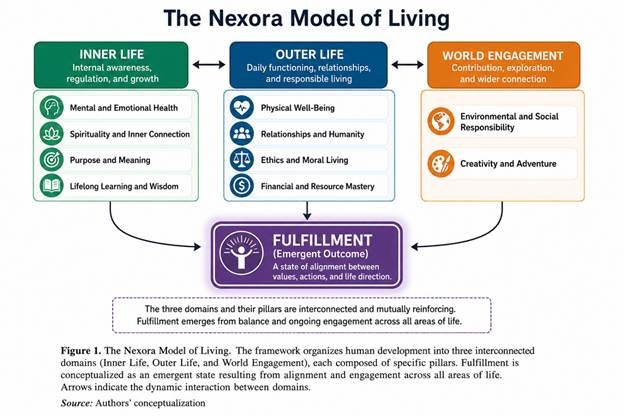
Figure 1. The Nexora Model of Living. The framework organizes human development into three interconnected domains (Inner Life, Outer Life, and World Engagement), each composed of specific pillars. Fulfillment is conceptualized as an emergent state resulting from alignment and engagement across all areas of life. Arrows indicate the dynamic interaction between domains.
Source: Authors’ conceptualization
4.3 Development of the Ten Pillars
Across the three domains, the Nexora Model identifies ten pillars representing key areas of human development. These were derived from recurring themes in literature on well-being, human functioning, and flourishing, as well as their relevance to everyday lived experience. Each pillar reflects a distinct dimension of growth while remaining connected to others (Diener et al., 2018; Ryff, 1989).
The Inner Life domain includes mental and emotional health, spirituality and inner connection, purpose and meaning, and lifelong learning and wisdom. These pillars emphasize self-awareness, regulation of internal experiences, and continuous cognitive and personal growth. They reflect how individuals interpret and manage their inner world, consistently linked to resilience, psychological stability, and long-term well-being (Keyes, 2007; Ryff & Singer, 2008).
The Outer Life domain focuses on how internal capacities are expressed in daily life. It includes physical well-being, relationships and humanity, ethics and moral living, and financial and resource mastery. These pillars demonstrate how individuals translate internal states into behavior, social interaction, and responsible living. These areas are essential for maintaining stability and effective functioning within families, workplaces, and communities (Cohen, 2004; Lusardi & Mitchell, 2014; Warburton et al., 2006).
The World Engagement domain highlights how individuals interact with broader systems beyond immediate personal and social environments. It includes environmental and social responsibility, as well as creativity and adventure. These pillars extend focus beyond the individual, emphasizing contribution, openness to experience, and engagement with wider social and ecological contexts. Such engagement has been associated with both personal fulfillment and collective well-being (Brown & Kasser, 2005; Csikszentmihalyi, 1996).
Although pillars are grouped within domains for conceptual clarity, they are not rigidly distinct. Human experiences often span multiple domains simultaneously. The organization is intended as a guide reflecting complexity and richness of human life rather than a fixed structure.
4.4 Central Role of Fulfillment
At the center of the Nexora Model is fulfillment. Fulfillment is understood as a state in which values, actions, and life direction are aligned. It reflects coherence and integration across multiple areas rather than attainment of a single goal. This perspective is consistent with eudaimonic approaches emphasizing meaning, self-realization, and purposeful engagement (Ryff & Singer, 2008; Seligman, 2011).
Within the Nexora Model, fulfillment is not an endpoint. It develops over time through continuous engagement with different life domains. When individuals maintain internal balance, cultivate supportive relationships, and engage meaningfully with the broader world, they are more likely to experience sustained satisfaction and direction. Purposeful activity, social connection, and opportunities for growth are central to well-being and long-term life satisfaction (Diener et al., 2018; Keyes, 2007).
Fulfillment is conceptualized as an emergent property of interaction among multiple dimensions. It does not arise from success in a single domain but from ongoing integration of internal experiences, external behaviors, and broader engagement with society and environment.
4.5 Interconnected Structure of the Model
A defining feature of the Nexora Model is the interconnected nature of its domains and pillars. These components do not function independently but continuously influence one another. This aligns with systems-based approaches emphasizing that psychological, social, and behavioral processes operate through dynamic interaction (Diener et al., 2018).
Improvements in physical well-being can enhance emotional stability and cognitive functioning; strong social relationships buffer stress and support resilience (Cohen, 2004; Warburton et al.,
2006). Engagement in lifelong learning influences decision-making and adaptability; a clear sense of purpose guides ethical behavior and social participation. These interactions demonstrate that development in one area often has ripple effects across others.
Initial pilot testing of the NMLS provided preliminary empirical support for this interconnected structure. The pilot data showed high internal consistency for the full scale (Cronbach’s α = 0.93) and domain-level alphas ranging from 0.76 to 0.89, suggesting domains capture related but distinct aspects. Domain-level mean scores showed small but meaningful differences: Inner Life (M = 3.68, SD = 0.98), Outer Life (M = 3.59, SD = 1.10), and World Engagement (M = 3.61, SD = 1.06). These findings, while preliminary, support theoretical distinction between domains and suggest the model’s structure is empirically coherent.
This interconnected structure highlights the importance of balance and integration. Rather than striving for perfection within a single domain, the model emphasizes coordinated growth across multiple areas. By presenting well-being as an integrated system, the Nexora Model provides a more realistic and comprehensive understanding of how individuals cultivate sustained fulfillment.
5.0 The Ten Pillars of the Nexora Model of Living
The Nexora Model conceptualizes human flourishing as a dynamic process shaped by interactions across multiple dimensions. To operationalize this, ten pillars are identified, each representing a key area through which individuals experience growth, responsibility, and meaning. These pillars are grounded in established research on well-being, behavior, and human development, while also reflecting practical aspects of everyday life (Ryff, 1989; Seligman, 2011).
The pillars are distributed across three domains: Inner Life, Outer Life, and World Engagement. The Inner Life domain focuses on internal awareness and personal development. The Outer Life domain reflects how internal capacities are expressed in daily functioning and relationships. The World Engagement domain extends focus to broader social and environmental contexts.
Although each pillar is described separately for clarity, they remain interconnected. Growth in one area can support development in others, while imbalance in any domain may affect overall well-being.
Table 1: Summary of the Ten Pillars of the Nexora Model of Living
| Pillar | Domain | Key Focus |
| Mental and Emotional Health | Inner Life | Emotional awareness, regulation, coping |
| Spirituality and Inner Connection | Inner Life | Values, beliefs, inner coherence |
| Purpose and Meaning | Inner Life | Direction, intentionality |
| Lifelong Learning and Wisdom | Inner Life | Growth, adaptability |
| Physical Well-Being | Outer Life | Health, lifestyle |
| Relationships and Humanity | Outer Life | Connection, empathy |
| Ethics and Moral Living | Outer Life | Values, responsibility |
| Financial and Resource Mastery | Outer Life | Stability, planning |
| Environmental and Social Responsibility | World Engagement | Impact, contribution |
| Creativity and Adventure | World Engagement | Exploration, openness |
5.1 Inner Life Pillars
The Inner Life domain forms the foundation of the model. It focuses on self-understanding, regulation of internal experiences, and development of meaning and direction. These processes shape how individuals interpret experiences, respond to challenges, and make decisions (Ryff & Singer, 2008).
5.1.1 Mental and Emotional Health
This pillar refers to the ability to recognize, regulate, and respond to thoughts and emotions in a balanced manner. It includes emotional awareness, stability, and capacity to cope with stress and uncertainty. Mental and emotional health emphasizes regulation and balance rather than meaning or direction. Individuals strong in this area are better equipped to maintain stability and recover from adversity. Emotional regulation and self-acceptance have been consistently associated with higher well-being and life satisfaction (Diener et al., 2018; Ryff, 1989).
5.1.2 Spirituality and Inner Connection
Spirituality involves a sense of alignment with one’s values, beliefs, and inner self. It is not limited to religious practice but includes reflection on deeper questions of identity, purpose, and existence. This pillar emphasizes awareness and inner coherence rather than goal-directed action. Practices such as meditation, reflection, or journaling may strengthen this dimension. A strong sense of inner connection has been linked to resilience, coping, and deeper meaning (Pargament, 2013).
5.1.3 Purpose and Meaning
Purpose and meaning refer to the extent to which individuals experience direction and intentionality. This pillar emphasizes alignment between personal values and long-term goals. Unlike spirituality, which centers on awareness, purpose focuses on direction and sustained engagement. Individuals with a clear sense of purpose are more likely to maintain motivation and persist through challenges. Meaning in life is strongly associated with resilience, psychological well-being, and long-term fulfillment (Ryff & Singer, 2008; Seligman, 2011).
5.1.4 Lifelong Learning and Wisdom
Lifelong learning refers to ongoing openness to acquiring knowledge, skills, and insight across the lifespan. It includes both formal education and experiential learning through reflection. This pillar emphasizes adaptability and cognitive growth. Continuous learning has been linked to improved problem-solving, critical thinking, and decision-making abilities essential for navigating complex situations (Schunk et al., 2019).
5.2 Outer Life Pillars
The Outer Life domain reflects how internal capacities are translated into action, relationships, and responsibilities. It encompasses behaviors supporting functioning within social and practical contexts.
5.2.1 Physical Well-Being
Physical well-being refers to maintaining bodily health through exercise, nutrition, rest, and preventive care. This pillar highlights biological and lifestyle factors supporting daily functioning. Physical health contributes to energy, cognitive performance, and emotional balance, and is strongly associated with quality of life (Warburton et al., 2006).
5.2.2 Relationships and Humanity
This pillar involves forming and maintaining meaningful, supportive, and respectful relationships. It includes empathy, communication, trust, and social connection. Relationships represent interpersonal functioning distinct from internal emotional processes. Strong social connections improve mental health, reduce stress, and enhance life satisfaction (Cohen, 2004).
5.2.3 Ethics and Moral Living
Ethics and moral living involve making decisions aligned with fairness, responsibility, and respect for others. It includes awareness of consequences of one’s actions. This pillar emphasizes moral reasoning and conduct rather than relationships themselves. Ethical awareness supports trust, accountability, and social cohesion, linked to responsible behavior across contexts (Kidder, 2005).
5.2.4 Financial and Resource Mastery
This pillar refers to responsible management of financial and material resources. It includes budgeting, planning, and informed decision-making. It emphasizes practical stability and distinguishes itself from broader subjective well-being. Financial competence has been associated with reduced stress, improved security, and better long-term outcomes (Lusardi & Mitchell, 2014).
5.3 World Engagement Pillars
The World Engagement domain focuses on how individuals contribute to and interact with systems beyond immediate personal and social environments.
5.3.1 Environmental and Social Responsibility
This pillar reflects awareness of one’s impact on society and environment, along with actions supporting sustainability and collective well-being. It emphasizes responsibility beyond the individual. Engagement in socially and environmentally responsible behaviors has been associated with both community well-being and personal fulfillment (Brown & Kasser, 2005).
5.3.2 Creativity and Adventure
Creativity and adventure involve openness to new experiences, ideas, and perspectives. It includes creative expression, exploration, and engagement with unfamiliar situations. This pillar emphasizes growth through novelty and experience. Creative engagement has been linked to personal development, adaptability, and life satisfaction (Csikszentmihalyi, 1996).
5.4 Integration of the Ten Pillars
Although each pillar represents a distinct dimension, they operate as part of an integrated system. Changes in one area often influence others. Improvements in emotional regulation can strengthen relationships; a strong sense of purpose can guide ethical behavior and social engagement.
The Nexora Model emphasizes integration rather than fragmentation. By supporting development across Inner Life, Outer Life, and World Engagement, individuals are better positioned to achieve sustained well-being and a meaningful, balanced life.
6.0 Proposed Conceptual Propositions
To support future empirical investigation, the Nexora Model can be expressed through conceptual propositions. These are testable assumptions reflecting the model’s structure and guiding further research.
Proposition 1: Balanced engagement across the three domains will be positively associated with overall fulfillment. Individuals with high scores across all three domains will report higher life satisfaction than those with high scores in only one or two domains.
Proposition 2: The Inner Life domain will show the strongest association with overall fulfillment, suggesting a foundational role for internal processes like emotional regulation and purpose.
Proposition 3: The Outer Life domain will show the strongest association with daily functioning and stability, reflecting its role in meeting practical life demands.
Proposition 4: The World Engagement domain will show the strongest association with meaning and long-term life satisfaction, reflecting its role in extending well-being beyond the individual.
Proposition 5: Interactions between domains will be dynamic and mutually reinforcing, such that improvements in one predict improvements in others over time.
Proposition 6: Imbalances across domains will be associated with reduced well-being, even when one or more domains are well developed, highlighting the importance of integration and balance.
These propositions provide a foundation for empirical testing. Preliminary pilot data offer initial support, with the three domains showing distinct mean scores and the full scale demonstrating high internal consistency. Future research may explore the strength of these relationships, variation across populations, and implications for interventions.
7.0 Discussion
The Nexora Model contributes to ongoing efforts to understand well-being as complex and evolving. Rather than treating well-being as fixed or as a set of parallel dimensions, the model emphasizes continuous interaction between internal states, everyday functioning, and broader engagement. This orientation aligns with literature viewing well-being as dynamic, context-dependent, and shaped by multiple interacting systems (Diener et al., 2018; Keyes, 2007).
A central contribution lies in the model’s integrative structure. Existing frameworks like Ryff’s model and Seligman’s PERMA have provided valuable insights into components of flourishing (Ryff, 1989; Seligman, 2011). However, these models often present well-being as a collection of domains or outcomes. While useful for research, this may not fully capture how individuals actively navigate different areas in practice. The Nexora Model builds on these foundations but shifts attention toward the process of living, where domains continuously influence one another.
This emphasis on interconnection is important. Research increasingly highlights that psychological, behavioral, and social factors do not operate in isolation. Social relationships influence mental and physical health (Cohen, 2004); lifestyle behaviors contribute to emotional regulation and cognitive functioning (Warburton et al., 2006). By explicitly incorporating interdependencies, the Nexora Model offers a structure reflecting real-life complexity more closely than models treating domains as independent.
Preliminary pilot data from the NMLS offer initial empirical support. The scale demonstrated high internal consistency (α = 0.93), and domain-level alphas ranging from 0.76 to 0.89 suggested the three domains capture related but distinct aspects. Domain-level mean scores showed small but meaningful differences: Inner Life (M = 3.68), Outer Life (M = 3.59), and World Engagement (M = 3.61). These findings, while preliminary, provide a foundation for further investigation and suggest the model’s structure is empirically plausible.
Another notable feature is inclusion of domains sometimes underrepresented in well-being frameworks. Ethical living, financial responsibility, and environmental engagement are often addressed separately but not integrated into a unified model. Yet these factors play meaningful roles in shaping individual and collective well-being. Financial literacy is linked to long-term stability (Lusardi & Mitchell, 2014); sustainability values are associated with personal and societal outcomes (Brown & Kasser, 2005). By incorporating these elements, the Nexora Model extends the scope of well-being beyond the individual.
The concept of fulfillment also offers a useful point of reflection. Rather than equating well-being with happiness or life satisfaction alone, the Nexora Model conceptualizes fulfillment as alignment between values, actions, and life direction. This view is consistent with eudaimonic approaches emphasizing meaning, purpose, and self-realization (Ryff & Singer, 2008). It resonates with research showing long-term well-being is closely tied to engagement in meaningful activities and development of coherent life narratives.
The model raises important questions for further inquiry. While the integrative approach is conceptually appealing, it requires empirical validation to determine how strongly proposed domains and pillars are related and whether certain elements play a more central role. Some domains may act as foundational drivers; others may have context-dependent effects. Longitudinal and cross-cultural studies will be important in examining these relationships and assessing stability across populations.
The ongoing development of the NMLS represents an important step. A structured measurement tool allows researchers to move beyond conceptual analysis and test the model empirically. This will help evaluate validity of the proposed structure and provide insights into how individuals engage with different life domains over time. Such work can contribute to both theoretical refinement and practical application.
In sum, the Nexora Model offers a perspective that is both integrative and process-oriented. It brings together insights from psychological, social, and behavioral research while extending the discussion to include ethical, financial, and environmental dimensions. By framing well-being as ongoing interaction across multiple domains, the model provides a useful lens for understanding how individuals work toward fulfillment within the complexity of everyday life. Continued empirical work will be essential in determining the strength and applicability of this framework.
8.0 Practical Applications and Theoretical Implications
The Nexora Model offers a structured yet flexible approach to understanding how different areas of life interact in shaping well-being and fulfillment. Rather than viewing domains in isolation, the model emphasizes interdependence. This perspective is consistent with research suggesting well-being emerges from interaction among multiple factors (Diener et al., 2018; Keyes, 2007).
In everyday life, the model can function as a guide for self-assessment and adjustment. Individuals often prioritize certain areas while neglecting others. Over time, imbalances affect emotional stability, relationships, and life satisfaction. The Nexora Model encourages a balanced approach by making patterns visible. Recognizing limited engagement in physical health or social connection may prompt deliberate changes. Research suggests balanced engagement across domains is associated with improved resilience and psychological well-being (Cohen, 2004; Ryff & Singer, 2008).
The model has relevance in educational contexts. Student development extends beyond cognitive performance to include emotional regulation, ethical reasoning, social competence, and purpose. Educational research supports holistic approaches integrating these dimensions (Schunk et al., 2019). By organizing these elements into interconnected domains, the Nexora Model can inform mentoring, student support services, and leadership development. A university might design a program including workshops on emotional regulation (Inner Life), financial literacy (Outer Life), and community engagement (World Engagement). This allows educators to move beyond fragmented interventions toward comprehensive student growth.
In workplace settings, the model provides a broader lens for understanding employee well-being and performance. Organizational research shows productivity is linked to mental health, meaningful work, and supportive relationships (Seligman, 2011). The inclusion of ethical behavior and financial management extends this perspective, recognizing professional effectiveness is shaped by personal and contextual factors. Employers can design policies supporting not only efficiency but also long-term well-being. An organization might offer mental health support (Inner Life), flexible work arrangements for physical health (Outer Life), and volunteer programs (World Engagement).
At the community level, the model highlights social and environmental engagement as integral to fulfillment. Participation in community activities, environmental initiatives, and creative pursuits has been associated with stronger purpose and social connection (Brown & Kasser, 2005). These forms of engagement reinforce that well-being is not solely individual but shaped by relationship with broader social and ecological environments.
From a theoretical standpoint, the model contributes to a more integrated understanding of human development. Traditional approaches have often focused on specific dimensions (Ryff, 1989; Seligman, 2011). While foundational, the Nexora Model extends this work by emphasizing dynamic interplay between internal experiences, external behaviors, and societal engagement. This aligns with systems-based perspectives conceptualizing well-being as shaped by continuous interaction across domains (Diener et al., 2018).
Inclusion of ethical living, financial literacy, and environmental responsibility further strengthens the model’s contribution. These areas are increasingly recognized as determinants of individual and societal outcomes, yet are often examined separately. By integrating them, the Nexora Model reflects modern complexity and offers a more comprehensive view of living well (Brown & Kasser, 2005; Lusardi & Mitchell, 2014).
Although the model remains conceptual, it provides a strong foundation for empirical investigation. The ongoing development of the NMLS will allow systematic assessment of proposed domains and pillars. This will enable researchers to examine how dimensions interact, relate to established well-being measures, and influence outcomes over time. The Nexora Model bridges theory and practice, offering both a conceptual framework and a pathway for future research.
9.0 Limitations and Directions for Future Research
Despite its conceptual strengths, the Nexora Model has several limitations. First, the model has not yet undergone full empirical validation. The relationships proposed among domains and pillars are grounded in existing literature but have not been systematically tested with primary data. The strength, direction, and significance of these relationships remain to be established. Future research should examine how domains interact in real-life contexts and assess association with outcomes like life satisfaction, resilience, and fulfillment (Diener et al., 2018; Keyes, 2007).
Second, although the model has begun to be operationalized through the NMLS, the instrument is still at an early stage. An initial pilot study with 147 participants provided preliminary evidence for coherence, showing high internal consistency (α = 0.93) and domain-level alphas from 0.76 to 0.89. However, the pilot sample was primarily students and young adults, limiting generalizability. The pilot also used an agreement-based format that may have encouraged acquiescence. These limitations have been addressed in the revised version, which now uses a truth-based format with a defined recall period. Comprehensive psychometric evaluation, including factor analysis and validity testing, is still required (DeVellis, 2017; Schunk et al., 2019). Validation across diverse samples will be essential.
Cultural and contextual variation represents another limitation. The importance of specific pillars like spirituality, financial responsibility, or social engagement likely differs across cultural settings, age groups, and socioeconomic contexts. What constitutes a meaningful life in one context may not fully translate to another. This highlights the need for cross-cultural research examining applicability and identifying areas for adaptation (Brown & Kasser, 2005; Keyes, 2007). Future research should specifically examine the model in non-Western populations and across age groups.
Practical application of the model has not yet been systematically evaluated. While the Nexora Model provides a structured understanding, its effectiveness in guiding behavior change remains open. Future research should investigate use in educational institutions, workplaces, and community programs. Intervention studies could determine whether engagement with the model leads to measurable improvements in psychological well-being, social functioning, and life satisfaction.
Another area for inquiry involves internal dynamics. It remains unclear whether certain domains play a more foundational role, or whether well-being is best achieved through balanced engagement across all domains. Longitudinal studies would be valuable in examining how individuals engage with different pillars over time and how shifts in one domain influence others.
Digital tools present a promising direction. Mobile applications or web-based platforms could support self-assessment, reflection, and personalized feedback. These tools may enhance user engagement and provide real-time data for research, allowing more nuanced analysis of how individuals interact with the model. Digital integration could also facilitate large-scale data collection.
The pilot study, while providing useful data, was limited by sample size (N = 147) and convenience sampling. The agreement-based format may have influenced response patterns, as indicated by skew toward agreement. These limitations have been addressed in the revised scale. Future validation should employ larger, more diverse samples, use the revised scale, and include advanced psychometric testing.
In summary, while the Nexora Model provides a comprehensive integrative perspective, it remains a developing framework. Continued empirical testing, scale validation, cross-cultural adaptation, and applied research will be essential. The pilot study serves as a foundation for the next phase, which will involve testing the revised 40-item scale with a larger, more diverse sample.
10.0 Conclusion
The search for balance and meaning remains central in both research and lived experience. Evidence increasingly suggests well-being cannot be reduced to a single dimension. Rather, it develops through interaction among psychological, social, behavioral, and environmental factors shaping how individuals think, act, relate, and engage (Diener et al., 2018; Keyes, 2007).
The Nexora Model brings these elements together within an integrated structure of ten pillars across Inner Life, Outer Life, and World Engagement. It highlights that personal reflection, everyday functioning, and broader societal participation are interconnected aspects of a meaningful life. Fulfillment is more likely to emerge when individuals attend to internal states, maintain supportive relationships, act with ethical awareness, and engage constructively with communities and environment.
The Nexora Model does not prescribe a fixed pathway to well-being. It offers a way of understanding how different dimensions interact over time. This process-oriented perspective reflects that individuals continuously adjust priorities in response to changing circumstances. By encouraging awareness of these interactions, the model provides a foundation for balanced, intentional living.
As a conceptual contribution, the Nexora Model establishes a basis for empirical investigation. The ongoing development of the NMLS, supported by pilot data demonstrating internal consistency and structural coherence, will enable researchers to examine the model’s structure and validity and explore how its domains relate to outcomes like life satisfaction, resilience, and personal growth. Such work will be essential in determining applicability across populations and contexts.
If validated empirically, the Nexora Model has potential to inform interventions, guide personal development, and support organizational policies fostering holistic well-being. It offers a structured yet flexible approach to understanding and promoting human flourishing in an increasingly complex world.
By drawing together insights from multiple disciplines into a coherent, human-centered framework, the Nexora Model offers a meaningful approach to understanding human flourishing. Continued refinement, empirical testing, and practical application will strengthen its contribution to both theory and practice.
Author Contributions
Eric Kwasi Elliason conceptualized the model, conducted the literature review, and drafted the manuscript. Surjeet Patheja provided critical feedback, supervised the development process, and contributed to the theoretical framing. Both authors reviewed and approved the final manuscript.
Funding
This research received no specific grant from any funding agency in the public, commercial, or not-for-profit sectors.
Conflict of Interest
The authors declare no conflicts of interest.
Data Availability
No primary data were collected for this conceptual paper. The pilot study data referenced are available from the corresponding author upon reasonable request.
References
Boateng, G. O., Neilands, T. B., Frongillo, E. A., Melgar-Quiñonez, H. R., & Young, S. L. (2018). Best practices for developing and validating scales for health, social, and behavioral research: A primer. Frontiers in Public Health, 6, 149. https://doi.org/10.3389/fpubh.2018.00149
Brown, K. W., & Kasser, T. (2005). Are psychological and ecological well-being compatible? The role of values, mindfulness, and lifestyle. Social Indicators Research, 74(2), 349–368. https://doi.org/10.1007/s11205-004-8207-8
Byrne, B. (2005). The wheel of life: Coaching tool for personal development. Coaching Today.
Cohen, S. (2004). Social relationships and health. American Psychologist, 59(8), 676–684. https://doi.org/10.1037/0003-066X.59.8.676
Cronbach, L. J. (1951). Coefficient alpha and the internal structure of tests. Psychometrika, 16(3), 297–334. https://doi.org/10.1007/BF02310555
Csikszentmihalyi, M. (1996). Creativity: Flow and the psychology of discovery and invention. HarperCollins.
DeVellis, R. F. (2017). Scale development: Theory and applications (4th ed.). Sage Publications.
Diener, E., Emmons, R. A., Larsen, R. J., & Griffin, S. (1985). The satisfaction with life scale. Journal of Personality Assessment, 49(1), 71–75. https://doi.org/10.1207/s15327752jpa4901_13
Diener, E., Oishi, S., & Tay, L. (2018). Advances in subjective well-being research. Nature Human Behaviour, 2(4), 253–260. https://doi.org/10.1038/s41562-018-0334-1
Keyes, C. L. M. (2007). Promoting and protecting mental health as flourishing: A complementary strategy for improving national mental health. American Psychologist, 62(2), 95–108. https://doi.org/10.1037/0003-066X.62.2.95
Kidder, R. M. (2005). Moral courage. HarperCollins.
Lally, P., van Jaarsveld, C. H. M., Potts, H. W. W., & Wardle, J. (2010). How are habits formed: Modelling habit formation in the real world. European Journal of Social Psychology, 40(6), 998–1009. https://doi.org/10.1002/ejsp.674
Linton, M. J., Dieppe, P., & Medina-Lara, A. (2016). Review of 99 self-report measures for assessing well-being in adults: Exploring dimensions of well-being and developments over time. BMJ Open, 6(7), e010641. https://doi.org/10.1136/bmjopen-2015-010641
Lusardi, A., & Mitchell, O. S. (2014). The economic importance of financial literacy: Theory and evidence. Journal of Economic Literature, 52(1), 5–44. https://doi.org/10.1257/jel.52.1.5
MacCallum, R. C., Widaman, K. F., Zhang, S., & Hong, S. (1999). Sample size in factor analysis. Psychological Methods, 4(1), 84–99. https://doi.org/10.1037/1082-989X.4.1.84
Pargament, K. I. (2013). Spiritually integrated psychotherapy: Understanding and addressing the sacred. Guilford Press.
Podsakoff, P. M., MacKenzie, S. B., Lee, J. Y., & Podsakoff, N. P. (2003). Common method biases in behavioral research: A critical review of the literature and recommended remedies. Journal of Applied Psychology, 88(5), 879–903. https://doi.org/10.1037/0021-9010.88.5.879
Ryan, R. M., & Deci, E. L. (2000). Self-determination theory and the facilitation of intrinsic motivation, social development, and well-being. American Psychologist, 55(1), 68–78. https://doi.org/10.1037/0003-066X.55.1.68
Ryff, C. D. (1989). Happiness is everything, or is it? Explorations on the meaning of psychological well-being. Journal of Personality and Social Psychology, 57(6), 1069–1081. https://doi.org/10.1037/0022-3514.57.6.1069
Ryff, C. D., & Singer, B. (2008). Know thyself and become what you are: A eudaimonic approach to psychological well-being. Journal of Happiness Studies, 9(1), 13–39. https://doi.org/10.1007/s10902-006-9019-0
Schunk, D. H., Meece, J. R., & Pintrich, P. R. (2019). Motivation in education: Theory, research, and applications (4th ed.). Pearson.
Schwarz, N. (1999). Self-reports: How the questions shape the answers. American Psychologist, 54(2), 93–105. https://doi.org/10.1037/0003-066X.54.2.93
Seligman, M. E. P. (2011). Flourish: A visionary new understanding of happiness and well-being. Free Press.
Streiner, D. L., Norman, G. R., & Cairney, J. (2015). Health measurement scales: A practical guide to their development and use (5th ed.). Oxford University Press.
VanderWeele, T. J. (2017). On the promotion of human flourishing. Proceedings of the National Academy of Sciences, 114(31), 8148–8156. https://doi.org/10.1073/pnas.1702996114
Warburton, D. E. R., Nicol, C. W., & Bredin, S. S. D. (2006). Health benefits of physical activity: The evidence. CMAJ, 174(6), 801–809. https://doi.org/10.1503/cmaj.051351
Zimmerman, B. J. (2002). Becoming a self-regulated learner: An overview. Theory Into Practice, 41(2), 64–70. https://doi.org/10.1207/s15430421tip4102_2