Interdisciplinary Journal of the African Alliance for Research, Advocacy and Innovation
IJAARAI
E-ISSN: 3093-4664
Racial Identity Disruption Syndrome (RIDS): Toward a Psychological Model of Racism and Colorism
Article Information
Abstract
Keywords
Full Article
Introduction
Racism and colorism have long been examined through sociological, historical, and political lenses, with sustained attention to structural inequality, institutional discrimination, and the enduring legacies of colonialism and exploitation (Allport, 1954; Myrdal, 1944; Bonilla-Silva, 2018). These approaches have been essential in documenting how racial hierarchies are constructed, normalized, and reproduced across societies. Yet, despite decades of legal reform, policy intervention, and public discourse, racialized patterns of exclusion, aggression, and dehumanization persist across cultural contexts. This persistence suggests that racism and colorism are not sustained solely through external structures, but are also maintained through internal psychological processes that shape identity, emotional regulation, and social perception.
Within psychological scholarship, racism has often been conceptualized as a learned attitude, an implicit bias, or a consequence of social categorization processes (Jones, 1997; Sue, 2010). Complementing these perspectives, neurocognitive research has demonstrated that racialized stimuli can activate threat detection and evaluative systems in the brain, particularly involving the amygdala and prefrontal regulatory networks (Phelps et al., 2000; Amodio & Devine, 2006). While these lines of inquiry provide important insight into the mechanisms underlying racial bias, they are frequently examined in isolation. As a result, the interconnections among social conditioning, identity development, affective dysregulation, and behavioral enactment remain insufficiently integrated within a single explanatory framework.
This conceptual fragmentation has limited the capacity of existing models to account for the durability and emotional intensity of racialized harm. Racism and colorism are rarely examined as disturbances of identity and belonging that operate simultaneously across cognitive, affective, relational, and neurobiological domains. Consequently, psychological processes that mediate the internalization and enactment of racial hierarchies remain undertheorized, particularly in relation to how identity insecurity and threat-based processing become self-reinforcing over time.
In response to this gap, the present paper proposes Racial Identity Disruption Syndrome (RIDS) as an integrative theoretical framework for understanding racism and colorism as manifestations of disrupted racial identity processing rather than solely ideological positions or moral failures. RIDS is conceptualized as a maladaptive internalization process in which race or skin color becomes disproportionately central to judgments of human worth, belonging, and social value. This distortion of identity is not innate, but emerges through prolonged exposure to racialized environments, early socialization, and experiences of threatened belonging. Over time, such influences may consolidate into rigid cognitive schemas, affective dysregulation, and heightened threat sensitivity that shape perception and behavior in persistent ways.
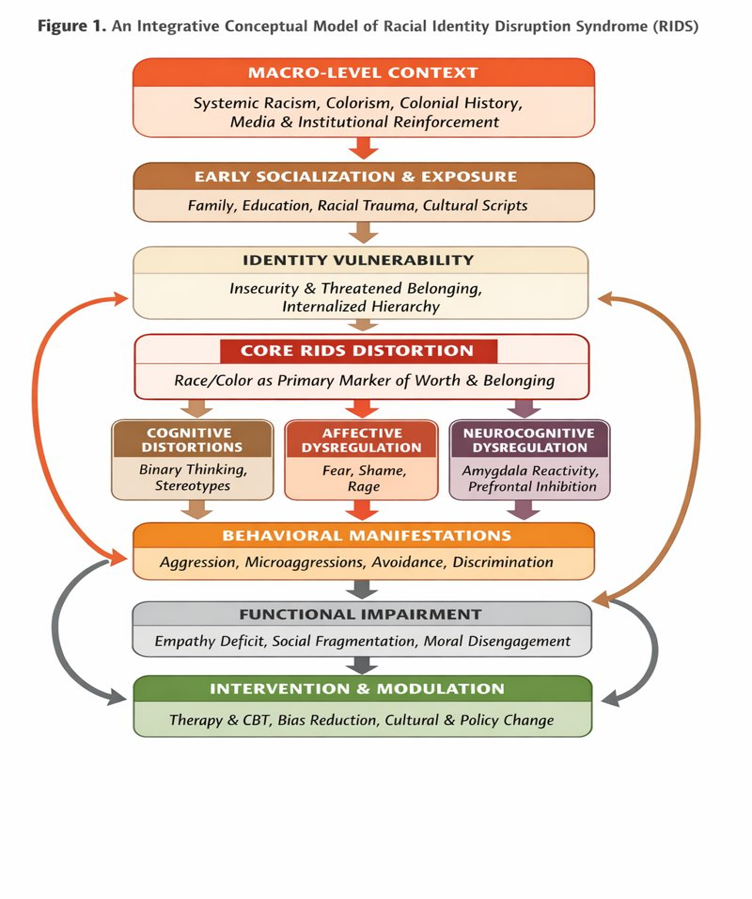
An integrative conceptual model is proposed to organize these processes and is presented in Figure 1. The model synthesizes social, psychological, and neurocognitive influences on racial identity processing and serves as an organizing framework for the theoretical background, phenomenological indicators, and intervention pathways developed in subsequent sections. Rather than offering a deterministic or diagnostic account, the model is intended to support ethical inquiry and empirical investigation into how racialized identity disruption is formed, maintained, and potentially transformed.
It is important to emphasize that RIDS is not proposed as a formal psychiatric diagnosis, nor as a moral indictment of individuals or groups. Instead, it is advanced as a heuristic and transdiagnostic construct designed to illuminate recurring psychological patterns associated with racialized identity disruption across diverse contexts. By framing racism and colorism as modifiable processes involving cognition, affect, neurobiology, and social reinforcement, the RIDS framework shifts attention toward prevention, intervention, and the restoration of belonging.
The purpose of this paper is to articulate the theoretical foundations of RIDS, examine its psychological and neurocognitive mechanisms, propose provisional phenomenological indicators, and outline multidisciplinary intervention pathways. Drawing on cognitive-behavioural theory, psychodynamic perspectives, social identity theory, and neuroscience, this work seeks to advance a more comprehensive and ethically grounded understanding of racism and colorism as disruptions of identity that affect both individuals and societies. Ultimately, the RIDS framework aims to contribute to scholarship, professional practice, and public discourse by offering a structured approach to understanding and addressing the psychological dimensions of racial harm.
Theoretical Background
Racial Identity Disruption Syndrome (RIDS) is grounded in an integrative body of theoretical traditions drawn from cognitive behavioral theory, psychodynamic theory, social identity theory, and contemporary neuroscience. Together, these perspectives provide a conceptual foundation for understanding how racism and colorism may operate not only as social and ideological systems, but also as internalized psychological processes that shape cognition, affect, and behaviour. This theoretical background situates RIDS within established scholarship while preparing the ground for its subsequent formulation as an integrative framework.
Cognitive Behavioural Perspectives
From a cognitive behavioral perspective, racism and colorism can be understood as manifestations of maladaptive cognitive processes similar to distortions observed across a range of psychological conditions (Beck, 1976). Within the RIDS conceptualization, individuals may selectively attend to racial or skin color cues and interpret social information through rigid evaluative schemas that equate race with value, status, or belonging. These schemas guide automatic categorization and appraisal of others, often resulting in biased judgments and emotionally charged responses.
Such cognitive patterns resemble the schema driven processing described in cognitive models of depression and anxiety, wherein distorted beliefs are maintained through feedback loops linking thought, emotion, and behaviour (Beck & Dozois, 2011). In the context of race, these feedback loops may reinforce anger, fear, or defensiveness, increasing the likelihood of discriminatory behaviour while simultaneously confirming existing beliefs about racial hierarchies.
Psychodynamic Perspectives
Psychodynamic theory offers additional insight into the internal mechanisms through which racism and colorism may be maintained. From this perspective, racialized attitudes and behaviours can function as ego defense mechanisms, including projection, displacement, and denial, through which individuals manage internal conflict, insecurity, or unmet psychological needs (Freud, 1930). Feelings of vulnerability or inadequacy may be externalized and attributed to racialized others, allowing the individual to preserve a sense of coherence, superiority, or belonging.
Within this framework, the racialized other becomes a symbolic container for disowned aspects of the self. Dalal (2002) argues that such processes reflect forms of psychic splitting in which internal fragmentation is regulated through externalized hostility or devaluation. These dynamics help explain the emotional intensity often associated with racist and colorist expressions, as well as their resistance to rational argument or factual correction.
Social Identity Perspectives
Social Identity Theory provides a further foundation for understanding the relational dimensions of RIDS. According to Tajfel and Turner (1979), individuals derive self esteem and meaning from group membership, with in group identification often strengthened through comparison with out groups. While such processes are normative, they become maladaptive when group boundaries are rigidified and linked to moral worth or human value.
In the context of racism and colorism, racial and skin color categories may become overinvested as markers of identity and status. This overinvestment can foster exclusion, dehumanization, and aggression toward out groups as a means of protecting a threatened or unstable sense of belonging. Within the RIDS framework, these group dynamics are viewed not simply as social strategies, but as psychologically compensatory processes that stabilize identity at the expense of relational and moral functioning.
Neurocognitive Perspectives
Advances in neuroscience have further illuminated the biological correlates of racialized perception and response. Neuroimaging studies demonstrate that exposure to racial or color based stimuli can activate brain regions involved in threat detection and emotional salience, including the amygdala, while regulatory regions in the prefrontal cortex play a critical role in modulating these responses (Phelps et al., 2000; Amodio & Devine, 2006).
Rather than conceptualizing these patterns as discrete neurological disorders, contemporary scholarship suggests that they reflect learned and reinforced neurocognitive tendencies shaped by social experience. Heightened threat sensitivity combined with reduced regulatory engagement may contribute to rigid categorization, diminished empathic resonance, and reliance on automatic responses. These findings provide important biological support for understanding how racial bias can persist even in the absence of conscious endorsement.
Toward Empirical and Ethical Validation
Although RIDS is introduced as a novel conceptual model, its core dimensions are supported by a growing empirical literature on internalized racism, identity fragmentation, projection, and cognitive affective dysregulation. Existing instruments such as the Internalized Racial Oppression Scale (Bailey et al., 2011), the Color-Blind Racial Attitudes Scale (Neville et al., 2000), and the Cultural Mistrust Inventory (Terrell & Terrell, 1981) demonstrate that identity related racial attitudes can be operationalized and systematically studied.
Quantitative research has linked internalized racism with depression, anxiety, low self-esteem, and difficulties in emotion regulation (Speight & Fiske, 2007; David et al., 2019). Neurocognitive studies further indicate that racial prejudice and dehumanization are associated with reduced activation in brain regions implicated in empathy and social cognition, including the medial prefrontal cortex (Harris & Fiske, 2006). Qualitative and mixed methods approaches, particularly those used in racial trauma research, offer additional insight into lived experiences of racial shame, superiority, and dissociation (Mosley et al., 2021).
Ethical considerations remain central to the development of RIDS. The construct is not intended to moralize or stigmatize individuals or groups, but to provide a diagnostic and restorative lens through which the psychological effects of racialized environments can be examined. Researchers and practitioners are encouraged to apply this model with cultural humility, historical awareness, and sensitivity to context, ensuring that it contributes to understanding and healing rather than further harm.
Integrative Orientation
Taken together, the theoretical perspectives outlined above provide a robust foundation for the RIDS model. By drawing on cognitive behavioral, psychodynamic, social identity, and neurocognitive traditions, this background establishes racism and colorism as complex phenomena operating across psychological, relational, and biological domains. This integrative orientation sets the stage for the subsequent theoretical framework, which specifies how these elements interact dynamically within the RIDS model.
Theoretical Framework of Racial Identity Disruption Syndrome (RIDS)
Building on established psychological, social, and neurocognitive theories of identity, affect regulation, and group dynamics (Beck, 1976; Tajfel & Turner, 1979; Phelps et al., 2000), Racial Identity Disruption Syndrome (RIDS) is conceptualized as a multilevel process through which racialized social environments interact with developmental experiences to disrupt identity formation, emotional regulation, and social cognition. As illustrated in Figure 1, RIDS emerges through the dynamic interaction of structural context, identity vulnerability, and interrelated cognitive, affective, and neurocognitive processes that shape behaviour and reinforce racialized systems over time.
Macro-Level Social Context
At the macro level, RIDS is embedded within racialized social environments characterized by systemic racism, colorism, historical trauma, and institutional reinforcement (Bonilla-Silva, 2018; Feagin, 2013). These contexts normalize racial hierarchies and associate social value with racial and skin colour categories. Repeated exposure to such environments shapes the salience of race in identity development and increases the likelihood that racial meaning becomes emotionally charged and morally overinvested.
Early Socialization and Identity Vulnerability
Early socialization processes play a critical role in shaping identity vulnerability. Family narratives, educational practices, peer interactions, and media representations transmit implicit racial scripts that influence self-concept and belonging from early life stages (Hughes et al., 2006; Sellers et al., 1998). Experiences of racial exclusion, privilege, or unresolved racial tension may contribute to a fragile or contingent sense of belonging.
Within the RIDS framework, identity vulnerability refers to a state in which self-worth and social inclusion feel unstable, increasing reliance on rigid identity markers for psychological security. Such vulnerability may manifest through internalized inferiority or defensive superiority, both of which heighten sensitivity to racial threat (Dalal, 2002).
Core Racial Identity Distortion
At the core of the framework lies a disruption in racial identity processing in which race or skin color becomes the primary determinant of human worth, moral status, and belonging. This distortion reflects a narrowing of identity in which racial categorization overrides complexity and individuality, a process consistent with cognitive schema theory and social identity consolidation (Beck & Dozois, 2011; Tajfel & Turner, 1979).
This core distortion functions as an organizing principle that shapes downstream cognitive appraisals, affective responses, and behavioural tendencies, often operating outside conscious awareness.
Cognitive, Affective, and Neurocognitive Processes
As shown in Figure 1, the core distortion manifests across three interconnected domains.
At the cognitive level, RIDS is characterized by rigid schemas, binary thinking, selective attention to racial cues, and projection, processes commonly associated with maladaptive belief systems (Beck, 1976).
At the affective level, these cognitive patterns are accompanied by dysregulated emotional responses, including fear, shame, rage, contempt, or defensiveness, particularly when racial assumptions or identity stability are challenged (Sue, 2010).
At the neurocognitive level, repeated exposure to racialized threat cues is associated with heightened activation of neural systems involved in emotional salience and threat detection, alongside reduced engagement of regulatory mechanisms (Phelps et al., 2000; Amodio & Devine, 2006). Over time, these patterns contribute to habitual, automatic responses that bypass reflective processing.
Behavioral Manifestations and Functional Impairment
The interaction of cognitive, affective, and neurocognitive processes gives rise to behavioural manifestations such as aggression, microaggressions, avoidance, discriminatory decision making, and dehumanization. These behaviours impair empathic functioning and disrupt interpersonal and social relationships, consistent with findings linking prejudice to reduced empathic neural engagement (Harris & Fiske, 2006).
Importantly, these behaviours also function as social signals that reinforce institutional norms and legitimize racial hierarchies, thereby feeding back into the broader social context (Jones, 1997).
Feedback Loops and System Reinforcement
A defining feature of the RIDS framework is the presence of recursive feedback loops. Behavioural expressions of racism and colorism reinforce macro-level structures, while social fragmentation and moral disengagement intensify identity vulnerability, increasing reliance on rigid racial schemas. This recursive dynamic helps explain the persistence and intergenerational transmission of racialized harm despite shifts in social norms or policy (Bonilla-Silva, 2018).
Points of Intervention and Modulation
Consistent with research on cognitive restructuring, trauma processing, neuroplasticity, and intergroup contact, the framework identifies multiple intervention points at individual, relational, and structural levels (Beck & Dozois, 2011; van der Kolk, 2014; Pettigrew & Tropp, 2006). By addressing both internal psychological processes and external reinforcements, the model conceptualizes racial identity disruption as modifiable rather than fixed.
Conceptual Model of Racial Identity Disruption Syndrome
Building on the theoretical perspectives outlined above, this paper proposes an integrative conceptual model to illustrate how racialized environments may give rise to recurrent patterns of identity disruption across cognitive, affective, relational, and neurocognitive domains. While each theoretical tradition offers valuable insight into specific mechanisms, their combined effects are often experienced simultaneously and recursively. The present model seeks to synthesize these perspectives into a coherent framework that captures the dynamic and self-reinforcing nature of racialized identity processes within broader sociocultural contexts.
The conceptual model, presented in Figure 1, depicts how rigid racial schemas, affective dysregulation, psychodynamic defenses, social identity dynamics, and threat-based neurocognitive responses interact over time to sustain patterns of relational harm and impaired empathy. Importantly, the model is not intended as a diagnostic algorithm or causal proof, but as a heuristic structure that organizes the phenomenological indicators, intervention pathways, and implications discussed in subsequent sections. By visually integrating psychological, relational, and structural influences, the model provides a unifying reference point for understanding Racial Identity Disruption Syndrome (RIDS) as a modifiable and context-dependent pattern rather than a fixed trait or pathology.
Provisional Clinical Indicators and Phenomenology of Racial Identity Disruption Syndrome (RIDS)
Racial Identity Disruption Syndrome (RIDS) is proposed as a heuristic and transdiagnostic construct intended to describe recurring patterns of racialized identity disturbance observed across cognitive, affective, and behavioral domains. The indicators outlined below are not intended to function as formal diagnostic criteria, nor are they proposed for inclusion in existing psychiatric classification systems. Rather, they are offered as phenomenological markers to guide clinical reflection, research development, and ethical inquiry into the psychological mechanisms through which racism and colorism may be internalized and enacted.
Consistent with the integrative framework illustrated in Figure 1, RIDS is characterized by disruptions in identity processing that produce measurable distress or relational impairment and are sustained through cognitive, affective, neurocognitive, and social reinforcement processes (Beck, 1976; Tajfel & Turner, 1979).
Core Phenomenological Features
Individuals exhibiting RIDS-related patterns may demonstrate persistent preoccupation with race or skin color as central determinants of human value, belonging, or moral status. This preoccupation often narrows identity complexity and constrains social perception, leading to rigid evaluations of the self and others.
These features must be understood within sociocultural context and should be interpreted with caution, cultural humility, and awareness of historical and structural influences.
Cognitive Indicators
At the cognitive level, RIDS may be reflected in maladaptive belief systems and schemas that prioritize racial categorization over individual or contextual information. Common indicators include:
- Rigid racial schemas characterized by binary or hierarchical thinking about race or color.
- Distorted racial self-concepts, including internalized superiority, inferiority, shame, or disassociation from one’s racial group.
- Projection of threat, deficiency, or hostility onto racialized out groups.
- Difficulty integrating nuance, intersectionality, or contextual variability into racial identity understanding.
These patterns parallel schema-driven distortions described in cognitive models of psychological dysregulation (Beck & Dozois, 2011).
Affective Indicators
At the affective level, RIDS is associated with dysregulated emotional responses linked to racial identity and intergroup engagement. Indicators may include:
- Chronic racialized anxiety, shame, contempt, or defensiveness associated with one’s own racial identity or that of others.
- Emotional numbing, avoidance, or withdrawal in response to discussions of race, history, or inequality.
- Heightened emotional reactivity, including anger or guilt, when confronted with racial ambiguity or equity challenges.
Such affective patterns are consistent with research on racial stress, microaggressions, and identity threat (Sue, 2010; Mosley et al., 2021).
Behavioral Indicators
Behavioral expressions of RIDS reflect the external manifestation of underlying cognitive and affective disruption. These may include:
- Engagement in racialized aggression or microaggressions, whether overt or subtle.
- Avoidance of cross-racial interactions or environments that challenge racial assumptions.
- Compensatory behaviors aimed at securing proximity to dominant racial norms or distancing from stigmatized identities.
- Dehumanizing language or practices that reduce empathy toward racialized others.
These behaviors align with findings linking prejudice to diminished empathic engagement and moral disengagement (Harris & Fiske, 2006).
Functional Impairment
For RIDS-related patterns to be considered clinically or socially significant, they must be associated with functional impairment. This may include:
- Disruption of interpersonal relationships
- Impaired empathic capacity
- Persistent social conflict or isolation
- Reduced capacity for reflective moral reasoning
Importantly, impairment may manifest both at the individual level and within broader relational or institutional contexts.
Specifier Patterns (Conceptual)
For research and clinical discussion purposes, RIDS-related patterns may be described using non-diagnostic specifiers that capture dominant modes of identity disruption:
- Internalized Superiority Pattern, characterized by entitlement, denial of inequality, and defensive racial narcissism.
- Internalized Inferiority Pattern, characterized by shame, erasure, or disidentification from one’s racial group.
- Fragmented or Context-Dependent Pattern, characterized by fluctuating racial identity expressions shaped by social context or trauma history.
These patterns are not mutually exclusive and may shift across time and environments.
Differential Considerations
RIDS must be clearly distinguished from normative expressions of ethnic pride, cultural identity, or racial consciousness. Unlike healthy identity affirmation, which fosters belonging and mutual respect, RIDS-related patterns involve rigidity, threat-based processing, and relational impairment. The presence of racial awareness alone should never be interpreted as indicative of identity disruption.
Additionally, RIDS-related indicators should not be conflated with adaptive responses to lived experiences of oppression or discrimination. Contextual analysis remains essential.
Ethical Positioning
The articulation of RIDS is guided by ethical commitments to non-stigmatization, cultural humility, and restorative intent. The construct is not intended to moralize, criminalize, or individualize responsibility for systemic racism. Instead, it seeks to illuminate how racialized environments shape psychological functioning across both marginalized and privileged groups, thereby opening pathways for healing, accountability, and transformation.
Proposed Intervention Framework
The intervention framework for Racial Identity Disruption Syndrome (RIDS) is grounded in the understanding that racialized identity disruption is not solely an individual phenomenon but an emergent process shaped by historical, relational, neurocognitive, and sociocultural forces. Accordingly, intervention strategies must operate across multiple levels, addressing cognitive-affective regulation, identity integration, relational repair, and systemic context. As illustrated in Figure 1, intervention points are conceptualized as interrupting self-reinforcing feedback loops that sustain racialized threat perception, identity fragmentation, and behavioral enactment.
The framework does not propose a singular treatment modality or standardized protocol. Rather, it offers a flexible, integrative scaffold that can inform clinical practice, educational programming, community dialogue, and policy-informed interventions, depending on context and ethical constraints.
Cognitive and Affective Recalibration
At the intrapersonal level, interventions may focus on identifying and restructuring rigid racial schemas that shape perception, evaluation, and emotional response. Drawing from cognitive-behavioural traditions, this process involves cultivating awareness of automatic racialized thoughts, examining their origins, and developing more nuanced and context-sensitive interpretations of racial difference (Beck & Dozois, 2011).
Affective recalibration is equally central. Techniques that enhance emotional regulation, distress tolerance, and reflective capacity may reduce threat-driven reactivity when racial identity is challenged. This process is not aimed at suppressing emotion, but at increasing the individual’s capacity to remain psychologically present and cognitively flexible during racially salient interactions.
Such interventions are most effective when implemented with explicit attention to sociocultural context, recognizing that emotional responses to race are often rooted in lived experience, historical memory, or internalized social narratives rather than individual pathology.
Psychodynamic and Identity-Oriented Work
From a psychodynamic and identity-focused perspective, intervention may involve facilitating insight into unconscious defense mechanisms that sustain racialized projections, splitting, or idealization. Therapeutic or reflective spaces can allow individuals to explore how unmet needs for safety, belonging, or self-worth have become symbolically attached to racial categories.
This work emphasizes integration rather than correction. The aim is to support the reconciliation of fragmented identity elements and to reduce reliance on externalized blame or idealized superiority as mechanisms of psychological stability (Dalal, 2002). Over time, increased insight may enable more authentic and less defensive engagement with difference.
Importantly, such work must proceed at a pace that respects psychological safety and avoids retraumatization, particularly in contexts involving racial trauma or historical oppression.
Relational and Intergroup Repair
Because RIDS manifests within relational and group contexts, intervention must extend beyond the individual. Structured intergroup dialogue, restorative practices, and facilitated encounters may serve as corrective relational experiences that counter dehumanization and rigid group boundaries.
When carefully designed, these interventions can promote perspective-taking, empathic resonance, and the rehumanization of racialized others. Research suggests that sustained, meaningful intergroup contact under conditions of psychological safety and equal status can reduce prejudice and threat-based responding (Allport, 1954; Pettigrew & Tropp, 2006).
Relational interventions should prioritize process over outcome and avoid forced reconciliation. Their purpose is not consensus, but increased tolerance for complexity, ambiguity, and shared humanity.
Neurocognitive and Embodied Regulation
Given evidence that racialized threat perception engages neural systems associated with fear, vigilance, and categorization, interventions that support embodied regulation may play a complementary role. Practices that enhance awareness of bodily states, such as mindfulness-based approaches or somatic regulation techniques, may help attenuate hyperreactivity and support executive functioning during racially charged encounters (Amodio & Devine, 2006).
These approaches are not positioned as cures, but as tools that support the neurocognitive conditions necessary for reflective processing, empathy, and moral reasoning.
Educational and Institutional Interventions
At the structural level, educational and institutional interventions are critical for reducing the conditions that perpetuate RIDS-related patterns. Curriculum reform, critical historical education, and organizational practices that address implicit bias and systemic inequality can disrupt the environmental reinforcement of racialized identity distortion.
Institutions such as schools, healthcare systems, media organizations, and law enforcement agencies represent powerful sites for either the reproduction or the repair of racialized narratives. Interventions at this level shift the focus from individual remediation to collective responsibility and prevention.
Ethical Orientation and Safeguards
All interventions informed by the RIDS framework must be guided by ethical principles of non-stigmatization, cultural humility, and contextual sensitivity. The framework explicitly rejects coercive, punitive, or moralizing approaches. Instead, it emphasizes restoration, accountability, and the cultivation of shared ethical responsibility for healing racialized harm.
Practitioners and institutions applying this framework should remain attentive to power dynamics, historical context, and the risk of reifying racial categories in the process of addressing them.
Implications for Research, Policy, and Practice
The conceptualization of Racial Identity Disruption Syndrome (RIDS) as a multi-level, relational, and neurocognitively mediated phenomenon carries important implications for future research, institutional policy, and professional practice. While the construct remains provisional, its integrative scope offers a unifying lens through which racialized cognition, affect, behavior, and social context may be examined in a coherent and ethically grounded manner.
Implications for Research
From a research perspective, RIDS provides a conceptual scaffold for investigating the psychological mechanisms through which racism and colorism are internalized and enacted across diverse populations. Future empirical work may focus on operationalizing the core dimensions of RIDS, including rigid racial schemas, affective dysregulation, identity fragmentation, and relational impairment.
Quantitative studies could examine the prevalence and correlates of RIDS-related patterns across sociocultural contexts, while testing their associations with mental health outcomes such as anxiety, depression, empathy deficits, and moral disengagement. Psychometric development remains a priority, with potential pathways including the adaptation or integration of existing measures related to internalized racism, racial stress, identity coherence, and intergroup attitudes (Neville et al., 2000; Bailey et al., 2011).
Qualitative and mixed-methods research can deepen understanding of lived experiences associated with racial identity disruption, particularly in contexts shaped by colonial histories, migration, or systemic inequality. Narrative and phenomenological approaches may be especially valuable in capturing the subjective meaning-making processes through which racial identity is negotiated and defended over time (Mosley et al., 2021).
Longitudinal research designs could further elucidate developmental trajectories, examining how early racial socialization, exposure to racial trauma, or institutional messaging contributes to the emergence, modulation, or resolution of RIDS-related patterns across the lifespan.
Implications for Policy
At the policy level, the RIDS framework underscores the need to move beyond individualistic explanations of racism and toward policies that recognize the psychological consequences of structurally racialized environments. Educational, healthcare, and criminal justice policies that fail to address the internalization of racial narratives risk perpetuating cycles of identity distortion and relational harm.
Policy initiatives informed by this framework may prioritize culturally responsive education, trauma-informed institutional practices, and equity-oriented organizational reforms. By acknowledging that racialized harm operates simultaneously at psychological and systemic levels, policymakers can design interventions that address both environmental conditions and their internal psychological sequelae.
Importantly, the framework cautions against the use of diagnostic or punitive approaches in policy contexts. Instead, it supports restorative, preventative, and developmental strategies that aim to reduce harm while fostering social cohesion and ethical accountability.
Implications for Practice
For practitioners in psychology, education, social work, and allied fields, the RIDS framework offers a reflective tool rather than a prescriptive model. Clinicians may use the construct to conceptualize racialized distress or defensiveness without prematurely pathologizing clients or minimizing the impact of systemic injustice.
In educational and organizational settings, the framework can inform the design of training programs, dialogue initiatives, and reflective practices that address racial identity complexity and emotional regulation. Practitioners are encouraged to approach such work with cultural humility, awareness of power dynamics, and sensitivity to historical context.
Across practice settings, the emphasis remains on fostering cognitive flexibility, emotional tolerance, and relational repair rather than enforcing ideological conformity or moral judgment.
Ethical and Societal Considerations
The introduction of RIDS as a conceptual framework necessitates ongoing ethical vigilance. Language, application, and dissemination must avoid reinforcing stigma or reducing complex sociopolitical phenomena to individual pathology. The framework’s utility lies not in labeling individuals, but in illuminating processes that are often obscured by moral polarization or ideological reductionism.
Used responsibly, the model may contribute to broader societal conversations about accountability, healing, and reconciliation by reframing racism as a shared human challenge with psychological, relational, and structural dimensions.
Limitations and Future Directions
While the Racial Identity Disruption Syndrome (RIDS) framework offers an integrative and interdisciplinary lens for understanding racialized identity disturbance, several important limitations must be acknowledged. These limitations are not weaknesses of the model per se, but reflect the early stage of its conceptual development and the ethical complexity of the phenomena it seeks to address.
Conceptual and Terminological Limitations
First, RIDS is proposed as a heuristic and exploratory construct rather than a validated diagnostic category. The use of the term “syndrome” is intended to denote a patterned constellation of psychological and relational processes, not to imply medicalization or inclusion within formal psychiatric nosologies. Nonetheless, the terminology may be interpreted differently across disciplines and cultural contexts, and future scholarship may benefit from continued refinement of language to ensure clarity, accessibility, and ethical appropriateness.
Additionally, although the framework integrates multiple theoretical traditions, it necessarily simplifies complex and dynamic processes. Psychological, social, and neurocognitive mechanisms are presented in an organized model for explanatory purposes, but in lived experience these processes are fluid, overlapping, and context dependent. Future work should continue to test and refine the boundaries and interactions among these domains.
Empirical Limitations
At present, the RIDS framework lacks direct empirical validation. While its core components are grounded in established research on internalized racism, identity development, affect regulation, and intergroup cognition, the model itself has not yet been operationalized or tested as a unified construct. This limits its immediate applicability in clinical or policy settings and underscores the need for systematic empirical investigation.
Future research should prioritize the development of psychometrically sound instruments capable of capturing the cognitive, affective, behavioral, and relational dimensions proposed within the model. Such tools must be developed with cultural sensitivity and tested across diverse populations to avoid ethnocentric bias or construct misapplication.
Cultural and Contextual Considerations
A further limitation concerns cultural variability. Experiences of race, colorism, and identity are shaped by distinct historical, political, and cultural conditions. As such, the manifestation of RIDS-related patterns may differ substantially across societies, communities, and identity groups. The current framework does not claim universality and should not be applied without careful contextual analysis.
Future research should engage cross-cultural, postcolonial, and Indigenous perspectives to ensure that the model remains responsive to diverse epistemologies and lived realities. Collaborative and community-engaged research approaches may be especially valuable in this regard.
Ethical Risks and Safeguards
There is an inherent ethical risk in conceptualizing racism-related processes through psychological frameworks, including the potential for stigmatization, misinterpretation, or misuse. Without careful framing, the model could be misapplied in ways that individualize responsibility for systemic harm or delegitimize justified emotional responses to oppression.
Future applications of the RIDS framework must therefore be accompanied by explicit ethical guidelines that emphasize its restorative intent, contextual grounding, and non-punitive orientation. Ongoing dialogue with scholars, practitioners, and affected communities will be essential to ensure responsible use.
Directions for Future Research and Development
Looking forward, several avenues for future work are indicated. Longitudinal studies could explore how racial identity disruption emerges, stabilizes, or resolves across the lifespan, particularly in relation to racial socialization, trauma exposure, and institutional contexts. Experimental and neurocognitive research may further clarify the biological and affective mechanisms associated with racialized threat processing and empathy regulation.
Intervention-focused research should evaluate the effectiveness of identity-integrative, relational, and systemic approaches informed by the RIDS framework, while maintaining ethical safeguards against coercion or moralization. Importantly, future scholarship should remain open to revising, expanding, or even abandoning the construct should empirical evidence or ethical considerations warrant such changes.
Conclusion
This paper has proposed Racial Identity Disruption Syndrome (RIDS) as a provisional, integrative framework for understanding how racism and colorism may become internalized and expressed through disrupted identity processing across cognitive, affective, relational, and neurocognitive domains. Rather than locating racism solely within individual moral failing or exclusively within structural systems, the RIDS model offers a relational and psychologically informed perspective that recognizes the reciprocal influence of social environments and internal processes.
Anchored in established theories from cognitive-behavioural psychology, psychodynamic traditions, social identity theory, and neuroscience, the framework brings coherence to a diverse body of scholarship that has often remained fragmented across disciplines. The conceptual model illustrated in Figure 1 provides a visual synthesis of these interacting processes, highlighting the self-reinforcing loops through which racialized threat perception, identity fragmentation, and behavioral enactment may be sustained over time.
Importantly, RIDS is not advanced as a diagnostic category or a mechanism for individual blame. Instead, it is presented as a heuristic construct intended to support ethical inquiry, empirical investigation, and reflective practice. By framing racialized harm as a modifiable and context-dependent pattern of identity disruption, the model opens space for interventions that emphasize integration, regulation, and relational repair rather than punishment or pathologization.
The paper has outlined provisional phenomenological indicators, a multi-level intervention framework, and implications for research, policy, and practice, while also acknowledging conceptual, empirical, and ethical limitations. This balanced approach reflects the complexity of racialized experience and the necessity of humility when engaging with historically and culturally charged phenomena.
Ultimately, the value of the RIDS framework lies not in its finality, but in its capacity to invite interdisciplinary dialogue and collaborative refinement. As scholars and practitioners continue to explore the psychological dimensions of racism and identity, models such as RIDS may contribute to a deeper understanding of how racialized harm is reproduced and, critically, how it may be transformed. Through continued empirical rigor, cultural sensitivity, and ethical accountability, this line of inquiry holds the potential to support more humane, reflective, and restorative approaches to racial healing and social cohesion.
References
Allport, G. W. (1954). The nature of prejudice. Addison-Wesley.
Amodio, D. M., & Devine, P. G. (2006). Stereotyping and evaluation in implicit race bias: Evidence for independent constructs and unique effects on behavior. Journal of Personality and Social Psychology, 91(4), 652–661. https://doi.org/10.1037/0022-3514.91.4.652
Bailey, T. K. M., Chung, Y. B., Williams, W. S., Singh, A. A., & Terrell, H. K. (2011). Development and validation of the Internalized Racial Oppression Scale for Black individuals. Journal of Counseling Psychology, 58(4), 481–493. https://doi.org/10.1037/a0023585
Beck, A. T. (1976). Cognitive therapy and the emotional disorders. International Universities Press.
Beck, A. T., & Dozois, D. J. A. (2011). Cognitive therapy: Current status and future directions. Annual Review of Medicine, 62, 397–409. https://doi.org/10.1146/annurev-med-052209-100032
Bonilla-Silva, E. (2018). Racism without racists: Color-blind racism and the persistence of racial inequality in America (5th ed.). Rowman & Littlefield.
Dalal, F. (2002). Race, colour and the processes of racialization: New perspectives from group analysis, psychoanalysis and sociology. Brunner-Routledge.
Freud, S. (1930). Civilization and its discontents (J. Strachey, Trans.). W. W. Norton. (Original work published 1929)
Hall, R. E. (2018). The global color line: Skin color, race, and power in global perspective. Springer.
Harris, L. T., & Fiske, S. T. (2006). Dehumanizing the lowest of the low: Neuroimaging responses to extreme out-groups. Psychological Science, 17(10), 847–853. https://doi.org/10.1111/j.1467-9280.2006.01793.x
Hughes, D., Rodriguez, J., Smith, E. P., Johnson, D. J., Stevenson, H. C., & Spicer, P. (2006). Parents’ ethnic–racial socialization practices: A review of research and directions for future study. Developmental Psychology, 42(5), 747–770. https://doi.org/10.1037/0012-1649.42.5.747
Hunter, M. (2007). The persistent problem of colorism: Skin tone, status, and inequality. Sociology Compass, 1(1), 237–254. https://doi.org/10.1111/j.1751-9020.2007.00006.x
Jones, J. M. (1997). Prejudice and racism (2nd ed.). McGraw-Hill.
Menakem, R. (2017). My grandmother’s hands: Racialized trauma and the pathway to mending our hearts and bodies. Central Recovery Press.
Mosley, D. V., Neville, H. A., King, J. L., & Smith, J. A. (2021). The racial trauma recovery framework: A trauma-informed approach for Black Americans. Counseling Psychologist, 49(2), 286–318. https://doi.org/10.1177/0011000020974264
Myrdal, G. (1944). An American dilemma: The Negro problem and modern democracy. Harper & Brothers.
Neville, H. A., Lilly, R. L., Duran, G., Lee, R. M., & Browne, L. (2000). Construction and initial validation of the Color-Blind Racial Attitudes Scale (CoBRAS). Journal of Counseling Psychology, 47(1), 59–70. https://doi.org/10.1037/0022-0167.47.1.59
Pettigrew, T. F., & Tropp, L. R. (2006). A meta-analytic test of intergroup contact theory. Journal of Personality and Social Psychology, 90(5), 751–783. https://doi.org/10.1037/0022-3514.90.5.751
Phelps, E. A., O’Connor, K. J., Cunningham, W. A., Funayama, E. S., Gatenby, J. C., Gore, J. C., & Banaji, M. R. (2000). Performance on indirect measures of race evaluation predicts amygdala activation. Journal of Cognitive Neuroscience, 12(5), 729–738. https://doi.org/10.1162/089892900562552
Sellers, R. M., Smith, M. A., Shelton, J. N., Rowley, S. A. J., & Chavous, T. M. (1998). Multidimensional model of racial identity: A reconceptualization of African American racial identity. Personality and Social Psychology Review, 2(1), 18–39. https://doi.org/10.1207/s15327957pspr0201_2
Speight, S. L., & Fiske, S. T. (2007). Racism, race-based stress, and health. In D. R. Williams & J. S. Jackson (Eds.), Racial disparities in health (pp. 45–70). Jossey-Bass.
Sue, D. W. (2010). Microaggressions in everyday life: Race, gender, and sexual orientation. Wiley.
Tajfel, H., & Turner, J. C. (1979). An integrative theory of intergroup conflict. In W. G. Austin & S. Worchel (Eds.), The social psychology of intergroup relations (pp. 33–47). Brooks/Cole.
Terrell, F., & Terrell, S. L. (1981). An inventory to measure cultural mistrust among Blacks. Western Journal of Black Studies, 5(3), 180–184.